AI is having its Oprah moment.
You get a certification!
You get a certification!
Everybody gets a certification!
Artificial intelligence is transforming professions, changing job responsibilities, creating new competency requirements, and generating plenty of anxiety about what comes next.
Naturally, associations are paying attention.
Boards are asking questions. Members are looking for guidance. Education teams are developing AI sessions. Conference programs are filling up with AI content.
And somewhere, in some association meeting happening right now, someone is probably asking:
Should we create an AI certification?
Maybe.
But before your association adds another certification program to its already overcrowded organizational garage, there is a much more important question:
Does your profession actually need one?
Because “AI is important” and “we should create an AI certification” are not the same strategic conclusion.
The AI Gold Rush Has Arrived
Associations have good reasons to be interested in AI.
Professionals need to understand how AI affects their work. Employers are trying to determine which AI competencies employees need. Members are looking to their associations for education, guidance, and leadership.
That creates opportunity.
It can also create pressure to move quickly.
Nobody wants their association to appear behind the curve. Nobody wants a competing organization to launch something first. And nobody wants to explain to the board why the association lacks an “AI strategy” when seemingly everyone else does.
So, the temptation is understandable:
Let’s create an AI certification!
The problem?
A certification should solve a workforce problem—not a marketing problem.
Start With the Profession, Not the Product
Before developing an AI certification, associations need to understand how AI is changing the profession they serve.
What tasks are changing?
What new responsibilities are emerging?
What knowledge and skills do professionals need?
What risks are employers trying to manage?
What competencies can be meaningfully assessed?
And perhaps most importantly:
Is there enough evidence that professionals and employers need formal recognition of those competencies?
If the answer is unclear, your association may not need an AI certification.
At least not yet.
It may need something else entirely.
Maybe You Need Education, Not Certification
This is where associations can get themselves into trouble.
A new topic emerges. Members want information. The association sees demand.
And the immediate response is to build a certification.
But demand for learning does not automatically equal demand for certification.
Your members may need:
-
- introductory AI education,
- role-specific workshops,
- practical application courses,
- ethical guidance,
- continuing education programs,
- conference sessions,
- communities of practice, or
- advanced professional development pathways.
Those options can help members develop AI competencies without requiring your association to build and maintain an entirely new certification program.
And that distinction matters.
A webinar can be created relatively quickly.
A certification program is a long-term organizational commitment.
A Certification Is Not Just Another Product
Creating a certification requires much more than developing a course, writing an exam, designing a badge, and announcing the program on LinkedIn.
A strong certification program requires strategy.
It requires research.
It requires clearly defined competencies.
It requires assessment development.
It requires governance.
It requires technology.
It requires marketing.
It requires candidate support.
It requires policies and procedures.
It requires continuing education and renewal strategies.
And it requires ongoing investment to ensure the certification remains relevant as the profession changes.
Now consider the speed at which AI is evolving.
The competencies professionals need today may look very different two years from now.
Or six months from now.
That does not mean associations should avoid AI certification.
It means they should be very clear about what they are committing to before they begin.
Ask Whether AI Is a Profession or a Competency
Here is another important question:
Are you certifying someone to work in AI, or helping professionals use AI effectively within their existing profession?
Those are very different things.
For many associations, AI may not need to become a separate certification.
Instead, AI competencies may need to be integrated into the association’s existing certification ecosystem.
That could mean updating:
-
- certification competencies,
- exam content,
- continuing education requirements,
- conference programming,
- professional development pathways,
- ethics guidance, or
- recertification expectations.
For example, a meeting professional may need to understand how to use AI responsibly in event design, data analysis, attendee communication, and operational planning.
Does that require a separate AI certification?
Maybe.
Or perhaps AI competency should become part of what it means to be a competent meeting professional.
That is the strategic conversation associations need to have.
Look at the Entire Certification Ecosystem
One of the biggest risks of creating a new certification is treating it as a standalone product.
Someone identifies an opportunity.
A committee is formed.
A program is developed.
A marketing campaign launches.
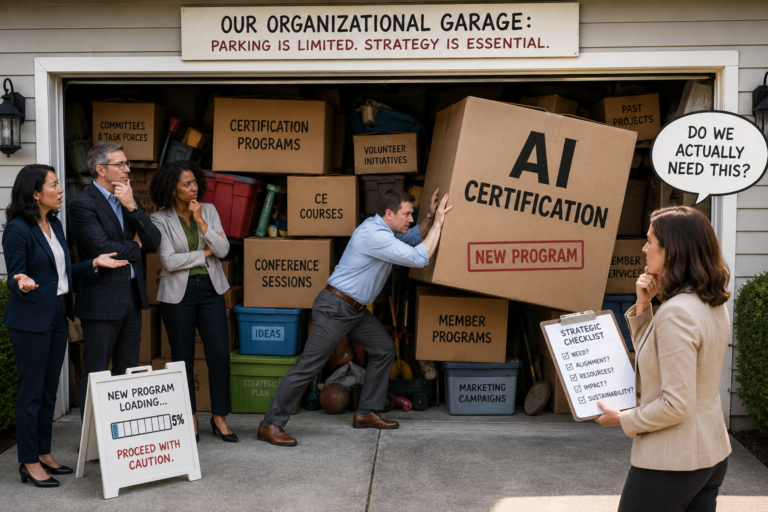
And congratulations—you now have another program competing for staff time, technology resources, marketing attention, conference space, and member dollars.
This is why associations need to evaluate new opportunities within the context of the entire certification ecosystem.
Before launching an AI certification, ask:
How does this program connect to our existing certification strategy?
Does it create a pathway into another certification?
Does it serve current certification holders?
Could it support continuing education or recertification?
How will it connect to our conference?
Does it strengthen member engagement?
Will employers recognize and value it?
Do we have the staff and technology infrastructure to support it?
How will we measure success?
A new certification should strengthen the ecosystem.
It should not simply add another disconnected program to the organizational garage.
Especially when nobody remembers where they put the garage door opener.
Beware of the “Everyone Else Is Doing It” Strategy
Competitive pressure is real.
If another association launches an AI certification, your board may ask why your organization has not done the same.
That is a fair question.
But the answer should not automatically be:
“Quick! Find a consultant and start writing exam questions!”
The better response is:
“Let’s determine what our profession needs and identify the best way for our association to meet that need.”
That might lead to a certification.
It might lead to a certificate program.
It might lead to a continuing education pathway.
It might lead to changes in an existing certification.
It might lead to an entirely different solution.
Strategy means choosing the right response—not simply the fastest response.
The Biggest Opportunity May Be Bigger Than an AI Certification
Here is where I think associations have an enormous opportunity.
AI is forcing professions to reconsider what competency looks like.
Jobs are changing.
Tasks are changing.
Decision-making is changing.
Employer expectations are changing.
The question is not simply:
“Should we create an AI certification?”
The bigger question is:
“How is AI changing our profession, and what does our association need to do about it?”
That conversation could affect your entire certification ecosystem.
It could influence certification standards.
Continuing education.
Conference programming.
Career pathways.
Member engagement.
Technology investments.
Employer relationships.
And your association’s role in shaping the profession’s future.
That is a much more important strategic conversation than deciding what to put on a new digital badge.
Before You Build, Diagnose
Your association may absolutely need an AI certification.
But you should know why.
You should understand the workforce needs.
You should know how the program fits within your existing certification ecosystem.
You should understand how it supports your association’s broader strategy.
And you should know what success will look like before you invest the time, money, and organizational resources required to build it.
Because the goal is not to have the newest AI certification.
The goal is to ensure that your association helps professionals develop the competencies they need to succeed.
Is your certification ecosystem prepared for the changes AI is bringing to your profession?
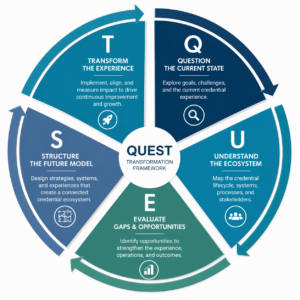
Start with the Certification Program Health Check to identify potential gaps, disconnected programs, and strategic opportunities within your certification ecosystem.
Then, set up a call with me to discuss your results. Together, we can look at what is working, what may be missing, and whether a new AI certification—or an entirely different strategy—is the right next move for your association.
Ellen Maiara, CMP, CED, is a Fractional Chief Experience Officer who helps credential-driven associations streamline certification, continuing education, conferences, learning lineups, and overwhelmed program teams, so credentialing becomes a scalable revenue engine.