A beautifully executed meeting isn’t necessarily a successful meeting. Strategic meeting planning starts by deciding what the meeting needs to accomplish—and then designing an experience that makes it happen.
I plan meetings.
But if the first conversation we’re having about your next conference is about whether you want chicken or salmon, we’re already several conversations behind.
Don’t get me wrong. I have opinions about banquet menus. After more than 25 years in this business, I have many opinions about banquet menus.
But none of them will tell us whether your meeting worked.
That’s because strategic meeting planning isn’t really about the meeting. It’s about what the organization needs the meeting to accomplish.
And that’s where event design begins.
The Meeting Is Not the Objective
Organizations invest an extraordinary amount of money, staff time, volunteer energy, and organizational bandwidth into meetings and conferences.
Then we sometimes measure success with:
- How many people attended?
- Did we stay within budget?
- Were the evaluations good?
- Did everyone like lunch?
Those are useful measures.
But there’s a much bigger question:
What changed because we brought these people together?
Maybe the meeting needs to increase member engagement.
Maybe it needs to strengthen your certification program.
Maybe you need to improve retention, generate revenue, educate your profession about an emerging issue, deliver greater value to sponsors, attract new participants, or reconnect an audience that has gradually become disengaged.
Whatever the answer is, we need to know it before we start designing the meeting.
Otherwise, we’re planning activities and hoping they somehow add up to results.
Hope is lovely.
It is not an event strategy.
Strategic Meeting Planning Starts With Better Questions
As a Certified Event Designer (CED), I approach meetings using event design methodology.
That means we don’t begin with:
“What did we do last year?”
That question has probably been responsible for more mediocre meetings than bad coffee and windowless breakout rooms combined.
Instead, we start with questions such as:
What does the organization need to accomplish?
Who are the stakeholders?
What do they need from this experience?
What do we want people to think, feel, know, or do differently because they participate?
What experience is most likely to create that change?
Where should we invest to make that happen?
How will we know whether it worked?
Those questions give us something incredibly valuable:
A reason the meeting looks the way it does.
Your Attendees Aren’t the Only Stakeholders
One of the principles of event design is understanding stakeholders.
And most meetings have more stakeholders than we initially realize.
There are attendees, certainly.
But there may also be:
Leadership.
Board members.
Staff.
Speakers.
Educators.
Sponsors.
Exhibitors.
Volunteers.
Members who aren’t attending.
Prospective members.
Certification candidates.
Industry partners.
Each group may define a successful meeting differently.
For example, an attendee may want education and meaningful connections.
A sponsor may want access to a particular audience and measurable engagement.
Leadership may be looking for increased member retention or revenue.
The education team may want participants to apply what they’ve learned after the meeting.
All those perspectives matter.
Good event design identifies where stakeholder needs and organizational objectives intersect—and builds the meeting around that intersection.
Where Should You Invest Your Meeting Budget?
Once we know what the meeting needs to accomplish, budgeting gets much more interesting.
Because now we’re not just asking:
“How much does this cost?”
We’re asking:
“Is this where our money will have the greatest impact?”
That’s a very different conversation.
Should you invest more in production?
Education?
Networking?
Technology?
Marketing?
Attendee acquisition?
Speakers?
Sponsor experiences?
Food and beverage?
The answer depends on what you’re trying to accomplish.
If networking is one of the primary reasons people attend your conference, giving them a 20-minute coffee break and saying, “Go network!” probably isn’t an event design strategy.
If education is your primary value proposition, filling agenda slots with 60-minute lectures because that’s how the grid has always looked deserves another look.
And if sponsors are investing significant dollars but their experience amounts to a six-foot table, two chairs, and the opportunity to watch attendees speed-walk toward lunch…
We may have some design work to do.
Strategic meeting planning helps organizations decide where to invest to create value, rather than simply repeating last year’s budget expenses.
Event Design Is About Creating Change
Here’s one of the distinctions I find most useful:
Don’t just ask what attendees will do at the meeting.
Ask what you want them to do differently as a result of the meeting.
That’s where things get interesting.
Maybe you want someone to pursue certification.
Renew their membership.
Apply something they learned.
Connect with colleagues they can turn to throughout the year.
Purchase another educational program.
Engage with a sponsor.
Volunteer.
Return next year.
Recommend the organization to a colleague.
When you identify the desired change, you can begin designing an experience capable of producing it.
Suddenly, the agenda isn’t just an agenda.
Networking isn’t just a reception.
Education isn’t just a collection of speakers.
Marketing isn’t just about registration.
The conference becomes part of a larger organizational strategy.
Your Meeting Planner Is Not the Problem
Here’s something else I want to make very clear.
You can already have an excellent meeting planner and still benefit from event design services.
In fact, I hope you do have an excellent planner.
I’m not suggesting that organizations replace the person who manages their meetings.
Meeting planning and event design serve different—but highly complementary—purposes.
Your meeting planner may be managing contracts, venues, registration, speakers, vendors, production, food and beverage, timelines, transportation, room blocks, and the approximately 4,782 other details required to get hundreds or thousands of humans into the right place at roughly the right time.
That’s important work.
Event design happens upstream.
I can work alongside your internal team, meeting professional, or planning company to help determine:
What does this meeting need to accomplish?
Then we can define stakeholder needs, identify desired outcomes, design the experience, determine where resources will have the greatest impact, and establish measures of success.
Your meeting professional then has something enormously valuable to execute:
A meeting designed with a clear purpose.
How Do You Measure Whether a Meeting Worked?
This is where many organizations have an opportunity to go much further.
We already measure plenty of things.
Attendance.
Revenue.
Room pickup.
Registration numbers.
Session evaluations.
Satisfaction scores.
Those metrics tell us something.
But they don’t necessarily tell us whether the meeting achieved its strategic objectives.
If the goal was member engagement, what happened afterwards?
If the goal was learning, what changed because of that learning?
If the goal was sponsor value, what did sponsors achieve?
If the goal was introducing participants to certification, how many moved into the certification pathway?
If the goal was retention, did the meeting influence the participant’s relationship with the organization?
This is why event measurements shouldn’t be invented after the closing general session.
We should define what success looks like while we’re designing the meeting.
That gives us a clear progression:
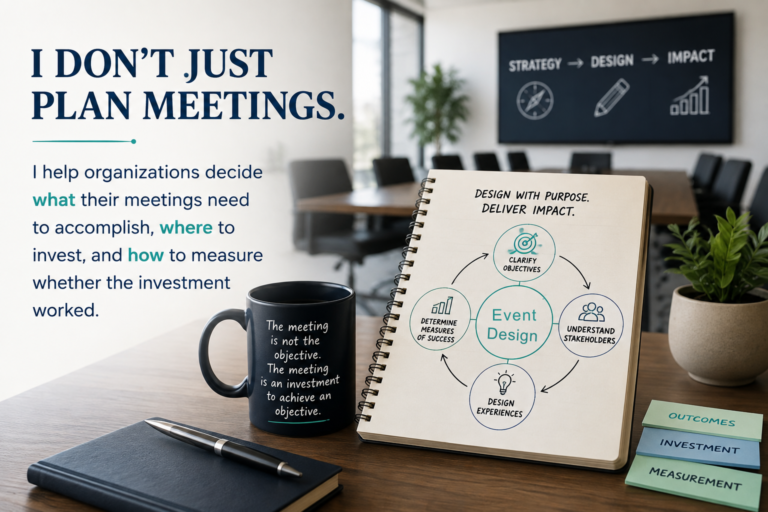
Organizational Objective → Stakeholder Needs → Event Design → Strategic Investment → Execution → Measurement
Now we aren’t simply reporting what happened.
We’re evaluating whether our investment worked.
Your Conference Doesn’t Exist in a Vacuum
This is particularly important for associations and certification-driven organizations.
Your annual meeting isn’t just a three-day event that magically appears on the organizational calendar every year.
It is potentially one of the most powerful engagement opportunities you have.
Someone may discover certification because of a conference session.
An educational experience may lead someone toward another program.
A networking experience may create a professional relationship that lasts for years.
An attendee may have an interaction that changes how they perceive the organization.
A sponsor may discover an entirely new way to partner with you.
A first-time attendee may become a member, a certification candidate, a volunteer, a repeat attendee, or a future leader.
When we think this way, the conference stops being an isolated event.
It becomes part of the organization’s broader ecosystem of engagement, education, certification, and revenue.
And that means it deserves to be designed accordingly.
I Don’t Just Want to Help You Plan the Meeting
I’ve spent my career planning meetings.
I can negotiate the hotel contract.
I can manage the budget.
I understand BEOs, room blocks, production schedules, registration, speakers, vendors, food and beverage, and all the details required to make a meeting happen.
And yes, if something goes sideways onsite, I understand that sometimes the official event-management methodology becomes:
Figure it out. Fix it. Keep smiling. The attendees must never know.
But that’s not where I believe my greatest value begins.
The most important question I can ask an organization is not:
“What do you want me to plan?”
It’s:
“What does this meeting need to accomplish?”
Because once we know that, we can design backward from the result.
And that changes everything.
Already Have a Meeting Planner? Let’s Talk About Event Design.
You don’t need to hand me your meeting to benefit from my experience.
My event design services can complement the meeting professional or internal team you already have.
I’ll work with your leadership and meeting stakeholders to clarify organizational objectives, understand stakeholder needs, identify the behaviors or outcomes you want the meeting to influence, evaluate where your event investment can have the greatest impact, and determine how success should be measured.
Then your meeting team has a strategic event design framework they can bring to life.
Have a major conference or meeting coming up?
Let’s have a conversation before the agenda, format, and budget are locked in.
Bring me the meeting you’re planning, the challenge you’re trying to solve, and what your organization needs to accomplish.
Schedule a call with me to discuss how event design can help turn your next meeting from an event you hold into an investment that delivers measurable results.
Because the meeting isn’t the objective.
The meeting is an investment made to achieve an objective.
And if we’re going to invest that much money, time, and energy bringing people together, shouldn’t we make sure we’ve designed it to do something?
About Ellen Maiara, CMP, CED
Ellen Maiara, CMP, CED, is a Fractional Chief Experience Officer who helps organizations turn meetings and certification programs into drivers of engagement, impact, and revenue. Using event design methodology, she helps organizations define what their meetings need to accomplish, design experiences around those outcomes, and measure what worked. Her certification ecosystem consulting aligns certification, education, events, and engagement to strengthen participation and revenue.