Preparing for the Certified Meeting Professional (CMP) exam requires focus, discipline, and — perhaps most importantly — time. One of the most common concerns I hear from meeting professionals is:
“How am I supposed to find time to study for the CMP?”
Between demanding event schedules, long workdays, and personal responsibilities, studying can feel impossible to fit into an already full calendar.
That’s where time blocking becomes a powerful tool.
Time blocking is one of the most effective time management strategies for CMP exam preparation because it ensures that the most important tasks — including your study time — actually happen.
Let’s explore how it works.
What Is Time Blocking?
Time blocking is the practice of scheduling every part of your day in advance.
And when I say everything, I mean everything.
- Work projects
- Meetings and appointments
- Meals
- Personal time
- Exercise
- And yes… CMP exam study time
At first, this might feel restrictive — almost like putting your life in a straight jacket.
But in reality, the opposite happens.
Time blocking actually reduces stress and anxiety because you remove one of the biggest drains on your energy:
constant decision-making.
Avoid Decision Fatigue
Throughout your day, your brain is constantly making decisions:
- Should I answer emails now or later?
- Should I start this project or that one?
- Should I study tonight or relax instead?
These small decisions create decision fatigue, which makes it harder to stay focused on important goals like preparing for the CMP certification exam.
When your schedule is already planned, you eliminate those decisions.
You simply finish one task and move on to the next.
How to Start Time Blocking for CMP Exam Prep
Here’s a simple step-by-step process you can use to organize your week and create dedicated time for CMP exam preparation.
Step 1: Plan Your Week in Advance
I recommend planning your week every Sunday.
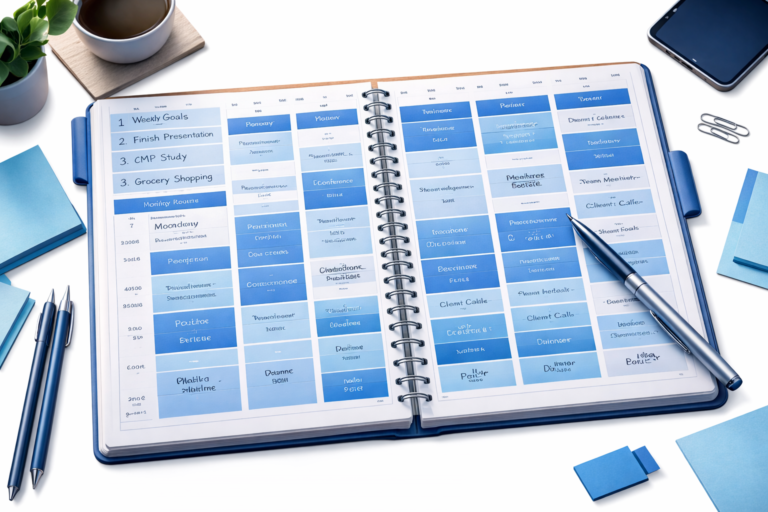
Use a time-blocking template, a planner, or a structured journal to map out your week.
Write in pencil or use erasable pens so you can adjust as needed.
Flexibility is important — life happens.
Step 2: Schedule Your Wake and Sleep Times
Start by blocking out:
- When you wake up
- When you go to bed
Sleep is critical for learning and memory retention, especially when studying for the Certified Meeting Professional exam.
Step 3: Schedule Your Daily Rituals
Next, block time for your daily routine.
For example, my morning ritual includes:
- Getting ready for the day
- Breakfast
- Exercise
- Meditation
- Reading a few pages of professional development
On my calendar, this simply appears as Morning Ritual and takes about 90 minutes.
Step 4: Add Your Fixed Commitments
Now enter appointments you’ve already committed to, such as:
- Work meetings
- Client calls
- Travel
- Personal appointments
These commitments take priority because they are already scheduled.
Step 5: Identify Your Weekly Goals
Choose 3–4 goals for the week. Some should be professional and some personal.
If you’re preparing for the CMP exam, one of those goals should be your CMP study tasks, such as:
- Attending your CMP study class
- Taking weekly quizzes
- Creating study note cards
- Writing practice questions
- Reading CMP materials
Breaking study into smaller tasks makes it much easier to stay consistent.
Step 6: Schedule Weekly Responsibilities
Now add routine tasks such as:
- Grocery shopping
- Meal planning
- Cleaning
- Laundry
- Errands
Planning these ahead of time prevents last-minute stress and helps you stay organized throughout the week.
Step 7: Don’t Forget the Fun
Your schedule should also include things you enjoy:
- Movie night
- Reading
- Date night
- Time with family
- Relaxation
Balance keeps you energized and motivated while preparing for the CMP exam.
Step 8: Fill the Remaining Time
Once your priorities are scheduled, look at the remaining open blocks in your week.
Each evening before finishing your workday, assign tasks to the open blocks for the following day.
The goal is simple:
Your daily schedule should have no empty gaps.
When your day begins, you already know exactly what you’re going to do.
And if something unexpected happens, simply adjust your schedule — that’s why you wrote it in pencil.
Why Time Blocking Works for CMP Candidates
The biggest benefit of time blocking is clarity.
You remove uncertainty from your day and replace it with a clear plan.
Instead of wondering when you’ll study for the CMP exam, your schedule already tells you.
And when your schedule tells you it’s time to study…
You study.

 Take the CMP Readiness Scorecard
 Live instructor-led classes