AI is moving quickly.
Board meetings? Sometimes not so much.
By the time the AI discussion finally makes it onto the agenda—somewhere between approving the minutes and reviewing the latest financial report—the conversation often begins with the wrong question:
“How should we use AI?”
That is an important question.
But for associations with certification programs, it is not the most important question.
The better question is:
“How is AI changing our certification ecosystem, and are we prepared to respond?”
Because AI is not simply another technology tool to evaluate.
It is changing how professionals work. How they learn. How they prepare for certification exams. How they access information. How associations collect and use data. And, perhaps most importantly, how professionals determine whether a certification is still valuable to their careers.
That means AI belongs in a much larger strategic conversation.
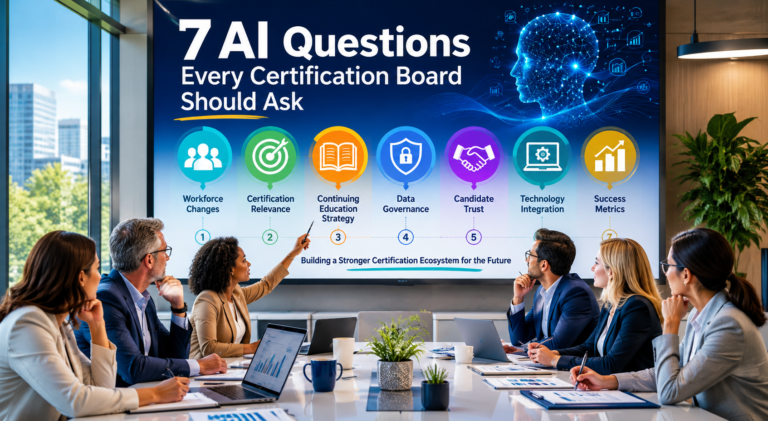
Here are seven questions every association board should be asking.
1. How Is AI Changing the Workforce We Serve?
Before discussing AI tools, associations need to understand how AI is changing the professions their certification programs support.
Which job responsibilities are disappearing?
Which are evolving?
What new skills are becoming essential?
Where is human judgment becoming more valuable rather than less?
These are not questions that should be answered once during a strategic planning retreat and then filed away for the next three years.
The workforce is changing too quickly.
Associations need ongoing mechanisms to gather information from employers, certified professionals, subject-matter experts, educators, and industry leaders.
Because if the profession changes but the certification program does not, a relevance gap begins to form.
And relevance gaps have a nasty habit of turning into revenue gaps.
2. Is Our Certification Still Measuring What Matters?
This may be one of the most uncomfortable questions a board can ask.
It may also be one of the most important.
If AI can perform tasks that were once considered essential professional competencies, should those tasks still receive the same emphasis within the certification program?
At the same time, are there new competencies that should receive greater attention?
Critical thinking.
Decision-making.
Ethics.
Communication.
Problem-solving.
The ability to evaluate AI-generated information rather than simply produce it.
A strong certification program cannot remain frozen while the profession changes around it.
The question is not whether the certification was relevant five years ago.
The question is whether it is preparing professionals for the work they need to do now—and the work they will need to do next.
3. Does Our Continuing Education Strategy Reflect the Speed of Change?
AI has created an interesting problem for associations.
Professionals need education faster than traditional education development models can provide.
A course designed today may not launch for months.
A conference session selected a year in advance may address a technology that has already changed significantly by the time the speaker walks onto the stage.
Meanwhile, members are looking for answers now.
This creates an enormous opportunity for associations willing to rethink continuing education within the broader certification ecosystem.
Instead of relying exclusively on annual conferences, webinars, and traditional courses, associations should consider how to create faster, more responsive learning opportunities.
Short-form education.
Expert briefings.
Peer learning.
Rapid response webinars.
Curated resources.
Communities of practice.
The goal is not to chase every shiny new AI tool that appears before lunch.
The goal is to become the trusted place professionals turn to when they need help understanding how industry changes affect their careers.
4. Who Owns Our AI and Certification Data Governance Strategy?
AI runs on data.
Unfortunately, many associations have certification data scattered across multiple systems that do not communicate particularly well.
The AMS knows one thing.
The LMS knows another.
The certification platform has additional information.
The conference registration system is off doing its own thing.
Marketing has spreadsheets.
Someone in accounting has another spreadsheet.
And there is probably at least one mysterious spreadsheet named FINAL_FINAL_USE_THIS_ONE.xlsx.
Before associations can fully use AI to improve their certification programs, they need to understand their data.
What data do we collect?
Where does it live?
Who has access to it?
How is it protected?
How accurate is it?
Can we connect data across the certification ecosystem?
AI strategy without data governance is not really a strategy.
It is wishful thinking with better software.
5. How Are We Protecting Candidate Trust?
Trust has always been essential to certification programs.
AI makes it even more important.
Candidates and certified professionals need confidence that the association is using technology responsibly.
How is AI being used in exam development?
How is candidate data being protected?
Are AI-generated educational materials being reviewed for accuracy?
Are policies clear about acceptable AI use?
Can candidates understand when and how AI influences their experience?
Associations cannot assume trust.
They must intentionally build and protect it.
Boards should ask not only what AI enables the organization to do, but also what the organization should do.
That distinction matters.
6. Can Our Technology Infrastructure Support the Certification Ecosystem We Are Trying to Build?
Many associations are excited about AI.
Their technology systems are less enthusiastic.
Before investing in new AI tools, boards should understand whether the existing technology infrastructure can support the organization’s strategy.
Can systems share data?
Can the association track a professional’s journey from initial awareness through certification, continuing education, renewal, and advocacy?
Can staff access meaningful information without manually combining reports from six different platforms?
Can leaders identify where professionals are disengaging?
Technology integration may not be the most exciting topic of conversation on the board.
Neither is plumbing.
But everyone notices when it stops working.
AI will not magically solve disconnected technology systems.
In some cases, it may simply help associations create bad reports faster.
7. How Will We Measure Whether Our AI Strategy Is Actually Working?
“We implemented AI” is not a success metric.
Neither is “staff attended a webinar about ChatGPT.”
Boards need to connect AI investments to measurable outcomes across the certification ecosystem.
For example:
Has candidate engagement improved?
Has certification participation increased?
Are more certified professionals participating in continuing education?
Has renewal improved?
Can staff make decisions more quickly?
Has manual work decreased?
Are professionals finding greater value in the association?
Can leadership identify trends and opportunities more effectively?
AI should not exist as a separate organizational initiative.
It should support measurable progress toward the association’s strategic goals.
The Bigger Question Boards Need to Ask
The conversation about AI is moving quickly.
But associations should resist the temptation to make AI strategy primarily about buying tools.
The real opportunity is much bigger.
AI is forcing associations to examine how professions are changing, how professionals learn, how certification programs remain relevant, how data is managed, how technology systems work together, and how success is measured.
In other words, AI is exposing the strengths—and the weaknesses—of the entire certification ecosystem.
That may be uncomfortable.
It is also incredibly useful.
Because the associations that thrive will not necessarily be the ones that adopt the most AI tools.
They will be the ones who ask better questions.
How Healthy Is Your Certification Ecosystem?
If your board is discussing AI, certification growth, continuing education, technology integration, data, or member engagement, the Certification Program Health Check is a good place to begin.
In just a few minutes, the Health Check can help identify strengths, gaps, and opportunities across your certification ecosystem.
Take the Certification Program Health Check and use the results to start a more strategic conversation with your leadership team and board.
Then, set up a call with me to discuss your results.
Together, we can look beyond individual programs and technologies to identify how your certification, education, events, data, marketing, and member engagement strategies can work as a single, connected ecosystem.
Because the future of your certification program will not be determined by whether your association uses AI.
It will be determined by whether your association is asking the right questions about what comes next.
Ellen Maiara, CMP, CED, is a Fractional Chief Experience Officer who helps credential-driven associations streamline certification, continuing education, conferences, learning lineups, and overwhelmed program teams, so credentialing becomes a scalable revenue engine.