7 Warning Signs Your Certification Ecosystem Needs Help
Key takeaway: Take the Certification Ecosystem Health Check. In just five minutes, you’ll gain valuable insights into the strengths, gaps, and opportunities within your certification ecosystem. The results often uncover challenges and opportunities that aren’t visible from day-to-day operations—and provide a clearer path toward growth, engagement, and long-term success.
Most association leaders can tell you how many certifications they awarded last year.
Many can tell you how many people attended their conference.
Some can tell you how many continuing education hours were completed.
But surprisingly few can answer a much more important question:
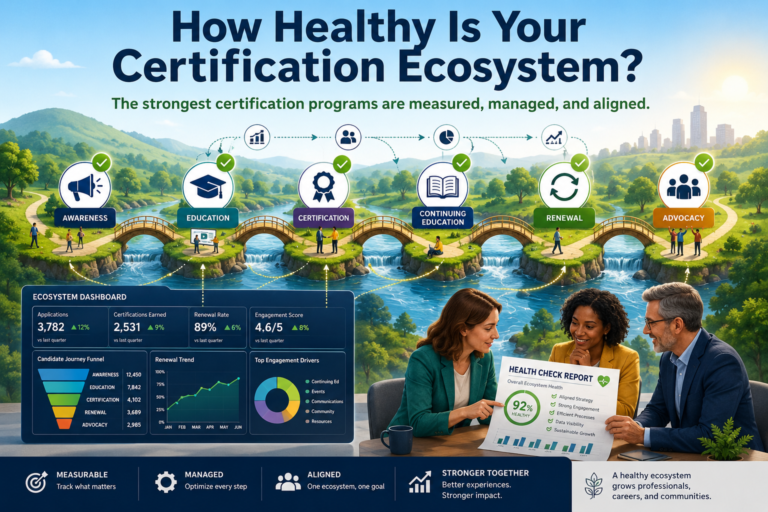
How Healthy is Your Certification Ecosystem?
That matters because certification success is rarely determined by a single program, event, or department. Instead, it is the result of dozens of interconnected experiences that influence whether a professional discovers your certification, prepares for it, earns it, maintains it, and ultimately becomes an advocate for your organization.
When those experiences work together, growth feels natural.
When they don’t, leaders often find themselves wondering why certification numbers have stalled despite investing more time, money, and effort.
The Difference Between Activity and Health
Many organizations measure activity.
They count registrations.
They count conference attendees.
They count continuing education completions.
They count certifications awarded.
Those metrics are important.
But activity alone doesn’t tell you whether your certification ecosystem is healthy.
Think about your own health for a moment.
A doctor doesn’t determine your health based solely on your weight or your heart rate. They evaluate multiple indicators to understand how all your systems work together.
Your certification ecosystem is no different.
You need to understand how the entire system functions, not just one piece of it.
Seven Signs of a Healthy Certification Ecosystem
1. Candidates Can Easily Understand the Path Forward
If prospective candidates struggle to understand:
-
- Eligibility requirements
-
- Application steps
-
- Exam preparation options
-
- Renewal expectations
you are likely losing qualified professionals before they ever begin.
A healthy certification ecosystem makes the journey obvious and easy to follow.
2. Education Supports Certification Goals
Many associations offer excellent educational content.
The question is whether that content supports certification success.
Can members clearly see how education helps them prepare for certification, maintain certification, or advance professionally?
When education and certification operate independently, opportunities are often missed.
3. Conferences Reinforce Certification Value
Your annual conference should be one of the most powerful drivers of certification engagement.
Attendees should encounter:
-
- Certification success stories
-
- Preparation resources
-
- Continuing education opportunities
-
- Renewal guidance
-
- Career advancement pathways
A healthy ecosystem connects conference experiences to long-term certification outcomes.
4. Renewal Feels Like Progress, Not Paperwork
Too many professionals view renewal as an administrative task.
The healthiest certification ecosystems help certification holders see renewal as ongoing professional growth.
When professionals understand how continuing education strengthens their careers, renewal rates often improve naturally.
5. Data Flows Across Systems
One of the biggest challenges I encounter is fragmented information.
The association management system knows one thing.
The learning management system knows another.
Certification records live somewhere else.
Marketing platforms have their own data.
When systems don’t communicate, leaders struggle to see the full candidate experience.
Healthy ecosystems create visibility across the entire journey.
6. Departments Work Toward Shared Outcomes
Certification teams, education teams, membership teams, marketing teams, and event teams often work incredibly hard.
The challenge isn’t effort.
The challenge is alignment.
When every team understands how their work contributes to certification growth, engagement increases, and member experiences become more seamless.
7. Leadership Can Clearly Measure Success
Healthy ecosystems are measurable.
Leaders should be able to answer questions like:
-
- Where are candidates dropping out?
-
- Which educational experiences drive certification applications?
-
- What influences renewal rates?
-
- Which programs create the most engagement?
-
- What barriers are slowing growth?
If those answers aren’t readily available, your organization may have blind spots that are limiting performance.
The Cost of Ignoring Ecosystem Health
Here’s what often happens when certification ecosystem health isn’t monitored:
-
- Certification growth stalls
-
- Renewal rates decline
-
- Education participation becomes inconsistent
-
- Staff workloads increase
-
- Member experiences become fragmented
-
- Revenue becomes less predictable
The frustrating part is that organizations often respond by adding more initiatives.
More marketing.
More courses.
More programs.
More technology.
But adding more pieces rarely solves a system problem.
Alignment does.
Start with a Health Check
The good news is that most challenges in the certification ecosystem are fixable once they’re visible.
That’s exactly why I created the Certification Ecosystem Health Check.
The assessment helps association leaders identify:
-
- Strengths within their certification ecosystem
-
- Hidden gaps affecting growth
-
- Opportunities for better alignment
-
- Areas that may be creating friction for candidates and certification holders
-
- Priorities for future improvement
Sometimes, a few small adjustments can create significant improvements across the entire system.
Sometimes the results uncover opportunities leadership hadn’t considered.
Either way, clarity is the first step.
Take the Next Step
If you’re responsible for certification, education, membership, events, or organizational strategy, now is the perfect time to evaluate the health of your certification ecosystem.
Take the Certification Ecosystem Health Check today.
Then schedule a conversation with me to review your results, discuss what they mean for your organization, and identify practical opportunities to strengthen your certification ecosystem.
The healthiest certification programs aren’t necessarily the largest.
They’re the ones where every part of the ecosystem works together to support professional growth.
And that’s where sustainable growth begins.
Ellen Maiara, CMP, CED, is a Fractional Chief Experience Officer who helps credential-driven associations streamline certification, continuing education, conferences, learning lineups, and overwhelmed program teams, so credentialing becomes a scalable revenue engine.