Let’s be honest.
Most continuing education programs look like someone emptied a filing cabinet onto a webpage and added a search filter.
Webinars. PDFs. On-demand courses. Conference sessions. Maybe a badge or two floating around somewhere.
Technically? It’s education.
Strategically? It’s a Costco-sized content warehouse with no map.
And then leadership wonders:
- Why do certification holders stop engaging after they pass
- Why CE revenue stalls
- Why conference attendance doesn’t convert into long-term participation
- Why do renewal rates feel unpredictable
- Why members say, “I’m not sure what I should do next”
Most CE programs are built like catalogs.
The best ones are designed like career pathways.
And that changes everything.
A Catalog Gives People Choices.
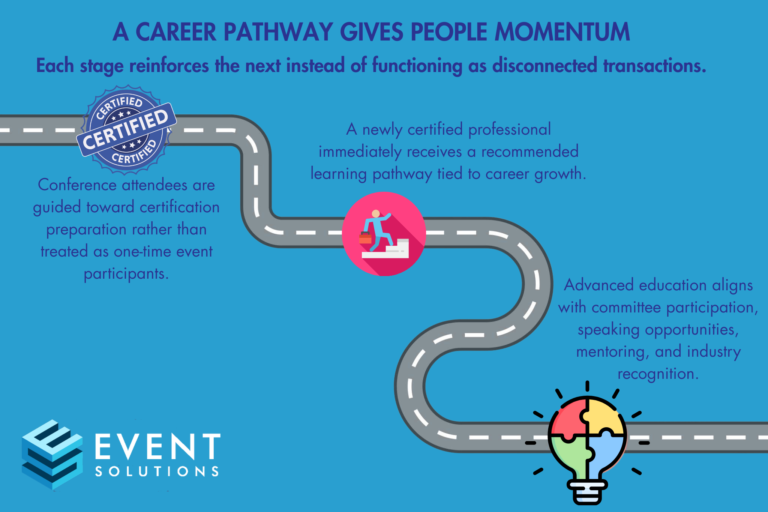
A Career Pathway Gives People Momentum.
Here’s the problem with the traditional CE model:
Associations often assume that if enough educational content exists, members will naturally figure out how to use it.
They won’t.
Not because they’re lazy.
Because professionals are overwhelmed.
When someone earns a certification, they don’t want 147 random course options.
They want answers to questions like:
- What should I learn next?
- How do I advance in my career?
- Which skills matter most right now?
- What path leads to leadership?
- How do I stay relevant in my industry?
A disconnected CE catalog creates decision fatigue.
A connected certification ecosystem creates direction.
That distinction matters more than most associations realize.
The Real Problem Isn’t Content. It’s a lack of Intentional Design.
Many associations already have excellent educational content.
The issue is that the pieces were built separately:
- Certification operates independently
- Conferences have their own strategy
- CE is managed somewhere else
- Learning pathways aren’t connected
- Marketing promotes everything equally
- No one owns the full member journey
So, members experience the organization like a shopping mall without signs.
Everything exists.
Nothing connects.
And when the handoffs between programs aren’t intentionally designed, growth stalls.
Not because the programs are bad.
Because the ecosystem is fragmented.
What the Best Certification Ecosystems Do Differently
High-performing associations don’t just deliver education.
They design progression.
They create systems where each experience naturally leads to the next.
For example:
Certification → Specialized Learning
A newly certified professional immediately receives a recommended learning pathway tied to career growth.
Conference → Certification Pipeline
Conference attendees are guided toward certification preparation rather than treated as one-time event participants.
CE → Leadership Development
Advanced education aligns with committee participation, speaking opportunities, mentoring, and industry recognition.
Learning → Renewal → Advancement
Each stage reinforces the next instead of functioning as disconnected transactions.
That’s not “more content.”
That’s ecosystem strategy.
And it’s why some associations create long-term engagement while others constantly fight churn.
Your Members Don’t Want More Options.
They Want Clarity.
This is the part organizations often miss.
Professionals today are exhausted by infinite choice.
Netflix syndrome has entered professional development.
If members must work too hard to figure out:
- what matters,
- what comes next,
- or how everything connects…
They disengage.
The associations winning right now are those that reduce friction.
They’re simplifying decisions.
Creating guided pathways.
Connecting learning experiences.
And designing progression intentionally.
The result?
- Higher certification renewal rates
- Increased CE participation
- Better conference engagement
- Stronger member retention
- More predictable non-dues revenue
- Greater long-term professional loyalty
Not because they created more programs.
Because they aligned the system.
The Future of Certification Growth Is Ecosystem Design
Here’s the uncomfortable truth:
Many associations are trying to solve growth problems with marketing campaigns when the real issue is a structural disconnect.
No campaign can permanently fix a fragmented experience.
Because growth doesn’t happen inside isolated programs.
Growth happens when the entire certification ecosystem works together.
That means:
- Certification
- Continuing education
- Conferences
- Learning pathways
- Member engagement
- Career progression
…all need to reinforce one another.
When they do, momentum builds naturally.
When they don’t, teams spend years trying to manually hold everything together.
Usually with spreadsheets.
And mild emotional damage.
Start Designing Now
If your organization is experiencing:
- stagnant certification growth,
- declining engagement after certification,
- disconnected CE offerings,
- or conference experiences that don’t drive long-term participation…
it may not be a program problem.
It may be a problem with the certification ecosystem.
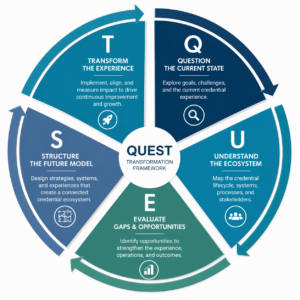
Start with the Certification Program Health Check to identify the gaps in your current ecosystem and uncover opportunities for growth, alignment, and operational clarity.
Then schedule a conversation with me to discuss how your association can move from fragmented programs to a connected certification ecosystem that drives engagement, renewals, and revenue.
Helpful Links
Ellen Maiara, CMP, CED, is a Fractional Chief Experience Officer who helps credential-driven associations streamline certification, continuing education, conferences, learning lineups, and overwhelmed program teams, so credentialing becomes a scalable revenue engine.