Most associations think they have a certification program.
What they have is a collection of disconnected activities wearing matching name badges.
The conference team is doing one thing.
Continuing education is doing another.
Certification operates in its own universe.
Marketing is sending emails into the void.
And leadership is wondering why growth feels harder than assembling IKEA furniture without the instructions.
Here’s the reality:
A successful certification program is not a single event, exam, or renewal process.
It’s an ecosystem.
And ecosystems only work when every stage is intentionally connected.
The Certification Ecosystem: Explained Simply
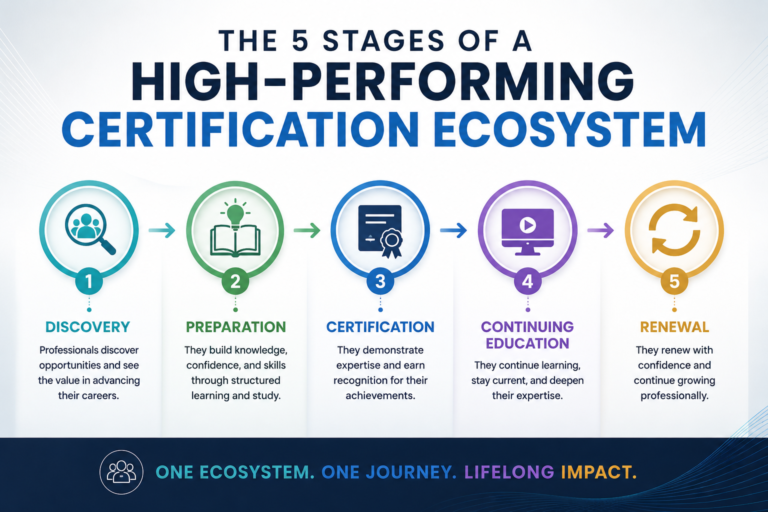
Most professionals move through the same five stages:
Discovery → Preparation → Certification → Continuing Education → Renewal
Sounds straightforward, right?
In theory, yes.
In practice? This is usually where things go sideways.
Let’s break down what each stage actually means — and where associations often lose people along the way.
Stage 1: Discovery
This is where someone first learns your certification exists.
Maybe they:
- Attend your conference
- Hear about the program from a colleague
- Find your content online
- Join your association
- Take a webinar
This stage matters more than many organizations realize.
Because people don’t wake up one morning and think:
“You know what sounds fun? A certification application.”
Discovery is about aspiration.
Professionals are asking:
- Will this help my career?
- Is this respected?
- Is this worth the investment?
- Do people like me succeed in this program?
If your conference, education, and marketing teams are not aligned around these questions, you create friction before candidates even begin.
And friction kills momentum.
Stage 2: Preparation
This is where candidates begin studying, engaging with education, and preparing for success.
Unfortunately, many certification ecosystems accidentally turn this phase into an obstacle course.
Candidates often experience:
- Confusing requirements
- Disconnected learning paths
- Poor communication
- Unclear timelines
- Overwhelming content
- Little emotional support
The result?
People disappear before they ever sit for the exam.
Strong certification ecosystems intentionally design preparation experiences that create confidence and momentum.
Because preparation is not just about content delivery.
It’s about helping professionals believe they can succeed.
Stage 3: Certification
This is the moment most organizations focus on.
The exam.
The pass rate.
The announcement post with confetti emojis.
And yes — certification matters.
But here’s the problem:
Many organizations treat certification as the finish line.
It isn’t.
It’s the midpoint.
If professionals earn the certification and then disappear from your ecosystem, the system is broken.
Certification should trigger:
- deeper engagement
- continuing education participation
- conference attendance
- volunteer leadership
- mentorship
- long-term professional growth
Without intentional design, certification becomes a transaction instead of a professional journey.
Stage 4: Continuing Education
This is where many ecosystems quietly leak revenue.
Many CE programs operate like giant content warehouses.
Courses everywhere.
Little strategy anywhere.
But the best certification ecosystems use continuing education to:
- reinforce professional identity
- create community
- drive recurring engagement
- support career advancement
- increase renewal success
- generate sustainable non-dues revenue
The difference is intentionality.
Organizations that win in this space do not simply “offer courses.”
They design learning pathways.
And yes — there’s a massive difference.
Stage 5: Renewal
Renewal is often treated like an administrative process.
Send a reminder email.
Collect payment.
Hope people renew.
But renewal is the ultimate metric of ecosystem health.
Because renewal tells you whether professionals still see value in staying connected.
Low renewal rates usually are not caused by:
- renewal forms
- reminder schedules
- payment systems
They are symptoms of something larger.
People disengage when the ecosystem stops feeling relevant, connected, or valuable between certification cycles.
That means the real renewal strategy starts long before the renewal notice goes out.
The Real Problem: Most Certification Ecosystems Were Never Designed
This is the part nobody likes to admit.
Many certification ecosystems evolved accidentally.
Different departments built different programs at different times.
Nobody mapped the entire professional journey.
Nobody designed the transitions between stages.
And those handoff points?
That’s where growth usually stalls.
Because disconnected experiences create:
- lower engagement
- lower renewal
- lower CE participation
- fragmented member experiences
- operational inefficiencies
- unpredictable revenue
The issue usually is not that individual programs are failing.
The issue is that the system itself was never intentionally connected.
What High-Performing Certification Ecosystems Do Differently
Organizations with strong certification ecosystems:
- Align conferences, certification, and CE around one professional journey
- Design intentional transitions between stages
- Use data to identify engagement gaps
- Create clear learning pathways
- Measure ecosystem-wide performance instead of isolated metrics
- Build experiences around professional growth, not departmental silos
The result?
Higher engagement.
Stronger renewal.
More predictable revenue.
Better member retention.
And significantly less operational chaos.
(Your staff may even stop stress-texting each other during conference season.)
No guarantees. But hope springs eternal.
Final Thought
Certification growth is rarely a marketing problem.
It’s usually a systems problem.
When discovery, preparation, certification, continuing education, and renewal operate as one connected ecosystem, growth becomes far more sustainable.
But when those stages operate independently, organizations end up fighting the same engagement battles year after year.
The good news?
Most ecosystems can be fixed.
But first, you must see where the gaps actually are.
Find the Hidden Gaps in Your Certification Ecosystem.
If your organization feels like:
- everything works…
- but nothing works together…
it may be time to evaluate the health of your certification ecosystem.
Start with the Certification Program Health Check to identify hidden gaps, operational friction, and missed growth opportunities.
Then schedule a conversation with me to discuss how your organization can move from fragmented programs to a connected certification ecosystem that drives engagement, renewal, and revenue.
Ellen Maiara, CMP, CED, is a Fractional Chief Experience Officer who helps credential-driven associations streamline certification, continuing education, conferences, learning lineups, and overwhelmed program teams, so credentialing becomes a scalable revenue engine.