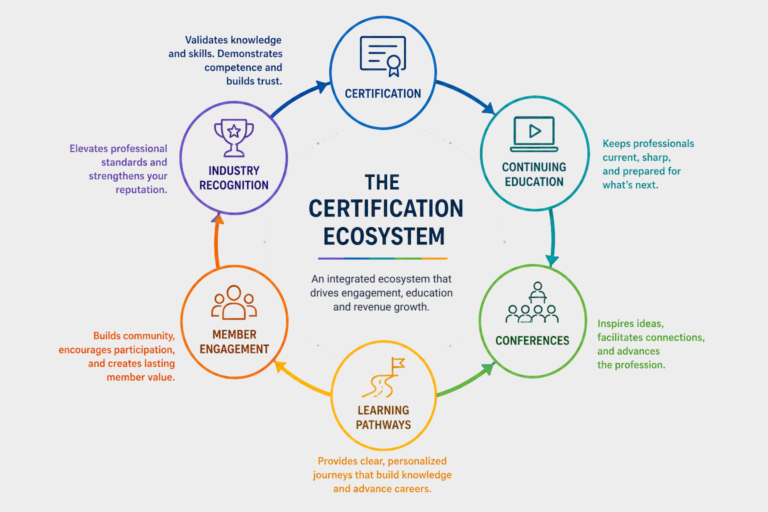
This diagram shows how a strong certification ecosystem works as a connected loop — not a one-and-done exam experience. Each piece feeds the next, creating ongoing professional growth, stronger member engagement, and long-term organizational value.
Here’s the breakdown:
1. Certification
“Validates knowledge and skills.”
This is the foundation. Certification demonstrates competence, builds trust, and gives professionals a recognized way to prove they know their stuff (without having to tattoo their résumé on their forehead).
Why it matters:
- Establishes professional standards
- Creates credibility
- Differentiates professionals in the market
- Builds employer confidence
But certification alone isn’t enough. If the ecosystem stops here, the value fades over time.
2. Continuing Education
“Keeps professionals current, sharp, and prepared.”
Industries evolve constantly. Continuing education keeps certified professionals relevant and engaged long after they pass the exam.
Why it matters:
- Supports skill development
- Encourages lifelong learning
- Increases retention and renewal rates
- Creates ongoing touchpoints with members
This is where many organizations either create momentum… or accidentally create a spreadsheet-powered chaos vortex.
3. Conferences
“Inspires ideas, facilitates connections, and advances the profession.”
Conferences bring the ecosystem to life. They create opportunities for networking, knowledge sharing, and professional inspiration.
Why it matters:
- Connects professionals to peers and industry leaders
- Reinforces the value of certification
- Generates content for future education offerings
- Drives engagement across programs
This is where people stop feeling like database records and start feeling like part of a professional community.
4. Learning Pathways
“Provides clear, personalized journeys.”
Learning pathways guide professionals toward growth instead of leaving them wandering through a maze of random webinars and PDFs titled “Final_v3_Updated_REALLYFINAL.”
Why it matters:
- Clarifies development opportunities
- Supports career advancement
- Aligns learning with certification goals
- Improves learner experience
A strong pathway strategy helps people answer:
“What should I do next?”
Without making them feel like they need a treasure map.
5. Member Engagement
“Builds community and lasting value.”
When professionals stay engaged, they renew their memberships, participate in programs, volunteer, advocate, and serve as ambassadors for the organization.
Why it matters:
- Increases retention
- Encourages participation
- Builds stronger communities
- Strengthens organizational loyalty
Engagement isn’t just emails and reminders. It’s creating experiences people want to return to.
6. Industry Recognition
“Elevates standards and strengthens reputation.”
When employers, regulators, and industry leaders recognize the certification, the entire ecosystem becomes more valuable.
Why it matters:
- Increases market demand
- Enhances professional credibility
- Strengthens the organization’s reputation
- Supports workforce development
This creates a reinforcing loop:
More recognition → More participation → More value → More recognition.
That’s the ecosystem working correctly.
The Big Picture
The key takeaway from this diagram:
None of these elements should operate in isolation.
Certification programs often struggle because departments function like disconnected islands:
- Education is doing one thing
- Conferences are doing another
- Membership is fighting fires
- Certification teams are drowning in manual processes
Meanwhile, learners are trying to navigate all of it while wondering:
“Why does this feel harder than filing taxes?”
A healthy certification ecosystem connects everything intentionally:
- Shared strategy
- Shared data
- Shared learner journeys
- Shared outcomes
When aligned, the ecosystem creates:
- Higher engagement
- Better learner experiences
- Stronger renewal rates
- Increased non-dues revenue
- Greater industry impact
Why This Matters for Associations
Organizations that treat certification as part of a larger ecosystem outperform organizations that treat it as a standalone product.
Because professionals don’t experience your organization in silos.
They experience:
- One journey
- One brand
- One relationship
The stronger the connections between these ecosystem components, the stronger the long-term value for both the learner and the organization.
Is Your Certification Ecosystem Working Together… or Quietly Creating Chaos?
If your certification program feels disconnected, overly manual, difficult to scale, or powered entirely by caffeine and crossed fingers, it may be time for a Certification Ecosystem Health Check.
Because here’s the truth:
Most organizations don’t have a certification problem.
They have an ecosystem alignment problem.
When certification, continuing education, conferences, learning pathways, membership, and industry engagement operate separately, the learner experience suffers — and so does your team.
A Certification Ecosystem Health Check helps identify:
- Operational bottlenecks
- Disconnected learner journeys
- Technology inefficiencies
- Engagement gaps
- Revenue opportunities
- Areas where teams, systems, and strategy are out of sync
The goal isn’t just to “fix” certification.
It’s to create a connected ecosystem that:
- Improves the learner experience
- Increases retention and renewal
- Supports staff efficiency
- Strengthens industry impact
- Builds scalable non-dues revenue
Ready to See What’s Working — and What’s Holding You Back?
Let’s schedule a conversation about your Certification Ecosystem Health Check.
Together, we can evaluate:
- Certification operations
- Continuing education alignment
- Conference integration
- Learning strategy
- Member engagement touchpoints
- Overall ecosystem performance
Because your certification ecosystem should feel intentional and scalable — not like a collection of disconnected systems held together by spreadsheets and hope.
Ellen Maiara, CMP, CED, is a Fractional Chief Experience Officer who helps credential-driven associations streamline certification, continuing education, conferences, learning lineups, and overwhelmed program teams, so credentialing becomes a scalable revenue engine.