Most associations are trying to solve revenue problems by looking at the wrong end of the telescope.
Membership is flat.
Conference attendance is unpredictable.
Sponsorship revenue fluctuates.
Continuing education participation rises and falls like a toddler’s mood before nap time.
When revenue becomes inconsistent, organizations often respond by launching new products, adding more courses, creating more programs, or introducing another technology platform that promises to solve everything.
Spoiler alert: it usually doesn’t.
The real solution is often hiding in plain sight.
It’s called your certification ecosystem.
The Difference Between Revenue and Predictable Revenue
Any organization can generate revenue.
A successful annual conference generates revenue.
A popular webinar series generates revenue.
A well-attended workshop generates revenue.
But predictable revenue is different.
Predictable revenue comes from creating a connected experience where participants naturally move from one engagement opportunity to the next.
Think of it like a road trip.
Many associations have built excellent destinations, but have forgotten to build the roads between them.
People attend a conference.
Then disappear.
They earn a certification.
Then disappear.
They complete continuing education.
Then disappear.
Every engagement feels like a one-time transaction rather than part of a larger journey.
A certification ecosystem connects those experiences into a pathway that encourages ongoing participation.
And ongoing participation creates recurring revenue.
The Leaky Bucket Problem
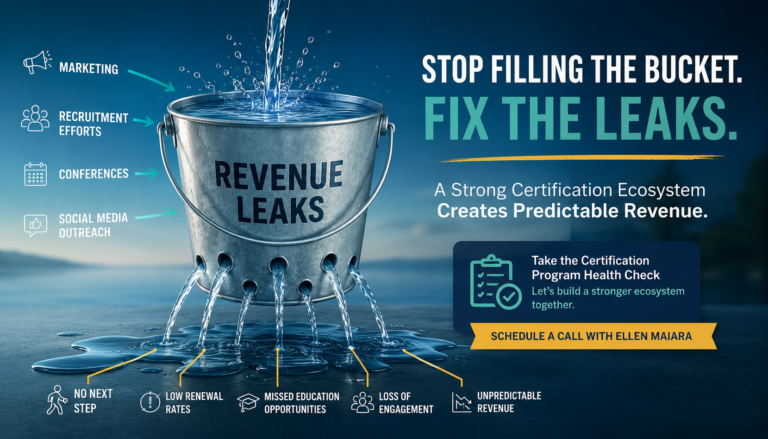
Imagine trying to fill a bucket while someone drills holes in the bottom.
That’s how many certification programs operate.
Organizations spend significant resources attracting new candidates.
Marketing campaigns.
Recruitment efforts.
Conference promotions.
Social media outreach.
But once someone earns certification, there is often no intentional strategy to guide them toward continuing education, renewal, advanced learning, volunteer opportunities, leadership roles, or future events.
The result?
Organizations constantly spend money replacing people who quietly drift away.
A strong certification ecosystem reduces those leaks.
Instead of repeatedly finding new participants, you create more value for the people already engaged with your organization.
That’s usually cheaper.
And significantly more profitable.
What Predictable Revenue Actually Looks Like
When certification programs operate as part of a connected ecosystem, something interesting happens.
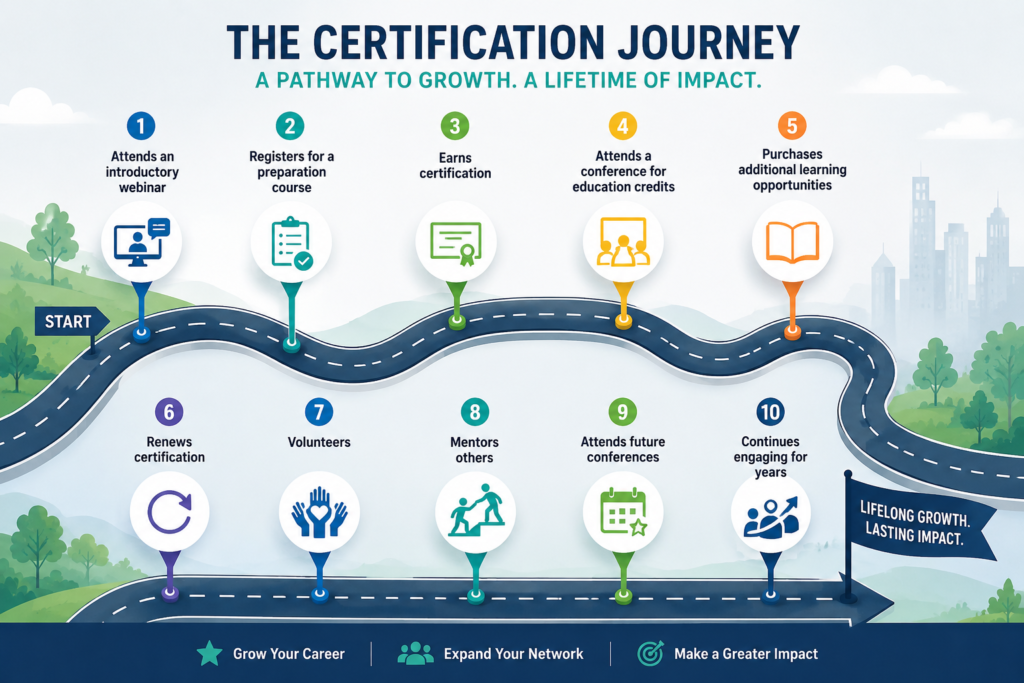
A candidate:
-
- Attends an introductory webinar
-
- Registers for a preparation course
-
- Earns certification
-
- Attends a conference for education credits
-
- Purchases additional learning opportunities
-
- Renews certification
-
- Volunteers
-
- Mentors others
-
- Attends future conferences
-
- Continues engaging for years
Each step creates value for the participant.
Each step also creates revenue opportunities for the organization.
The magic isn’t any single program.
The magic is the connection between them.
Why Some Certification Programs Grow Faster Than Others
Here’s a secret.
The fastest-growing certification programs are not always the ones with the best exams.
They’re often the ones with the best ecosystems.
Participants know:
-
- What comes next
-
- Why it matters
-
- How to get there
-
- What value they’ll receive
The experience feels intentional.
Not accidental.
Not confusing.
Not buried somewhere on page 47 of the website, where information goes to die.
When people understand their next step, participation increases.
When participation increases, revenue becomes more predictable.
It’s surprisingly simple.
Not easy.
But simple.
Signs Your Certification Ecosystem Needs Attention
You may have an ecosystem challenge if:
-
- Certification growth has stalled
-
- Renewal rates are declining
-
- Continuing education participation is inconsistent
-
- Conference attendees aren’t moving into certification programs
-
- Certified professionals aren’t attending events
-
- Multiple departments operate independently
-
- Staff spend excessive time on manual workarounds
-
- Leadership struggles to see the full participant journey
If any of these sound familiar, you’re not alone.
Many organizations built their programs over decades.
One initiative at a time.
One department at a time.
One technology purchase at a time.
Eventually, the ecosystem becomes a collection of disconnected parts rather than a coordinated strategy.
The Opportunity Most Organizations Miss
Certification is not simply a program.
It’s a growth strategy.
When designed intentionally, certification can become the connecting thread that links learning, events, engagement, retention, and revenue.
Organizations that understand this create systems that generate participation repeatedly rather than relying on constant acquisition.
That’s how predictable revenue is created.
Not through more programs.
Through better connections.
Ready to See How Healthy Your Certification Ecosystem Really Is?
Most organizations have blind spots.
The challenge is identifying them before they become revenue problems.
Start with the Certification Program Health Check.
The assessment helps identify gaps, disconnects, opportunities for growth, and areas where revenue may be leaking out of your ecosystem.
After you’ve completed the Health Check, let’s talk.
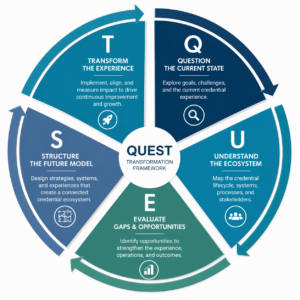
Schedule a conversation with Ellen Maiara to review your results, compare findings, and discuss practical strategies, using her Quest MethodologyTM, to strengthen your certification ecosystem and create more predictable revenue.
Because the goal isn’t simply to grow certification.
The goal is to build an ecosystem that grows everything around it.
Ellen Maiara, CMP, CED, is a Fractional Chief Experience Officer who helps credential-driven associations streamline certification, continuing education, conferences, learning lineups, and overwhelmed program teams, so credentialing becomes a scalable revenue engine.