Most certification-driven organizations think they’re managing a certification program.
They’re not.
They’re managing an ecosystem.
The problem is that many organizations don’t realize the difference.
As a result, they spend enormous amounts of time optimizing individual programs while the overall experience remains fragmented.
It’s like owning a zoo and focusing exclusively on feeding the giraffes.
The giraffes may be thriving.
The rest of the animals? Not so much.
The Program Mindset
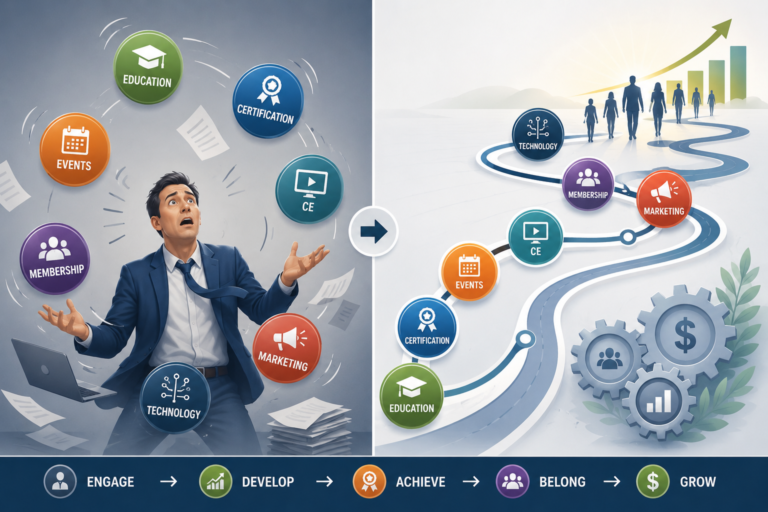
A program mindset focuses on individual activities.
The certification team worries about exam applications.
The education team focuses on course registrations.
The events team concentrates on conference attendance.
The membership team tracks renewals.
The marketing team promotes each initiative independently.
Everyone works hard.
Everyone is busy.
Everyone has dashboards.
Yet growth still stalls.
Why?
Because optimizing individual programs does not automatically create a cohesive experience.
Professionals don’t experience your organization in departments.
They experience it as one journey.
And when that journey feels disconnected, engagement suffers.
The Ecosystem Mindset
Most organizations are structured around departments.
Education has goals.
Certification has goals.
Membership has goals.
Events have goals.
Marketing has goals.
The problem is that professionals don’t care about your organizational chart.
They care about solving problems, advancing their careers, and finding value.
When every department operates independently, the experience can feel like a series of unrelated transactions. A professional registers for a course, attends a conference, earns certification, and renews membership without any clear connection between those activities.
An ecosystem mindset changes that.
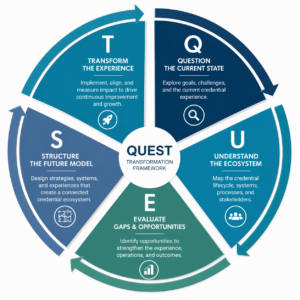
Instead of measuring the success of each program separately, it assesses how each program contributes to a broader professional experience.
Education supports certification.
Certification increases conference engagement.
Conferences create opportunities for continuing education.
Continuing education supports renewal.
Renewal creates long-term participation and leadership opportunities.
Suddenly, individual programs stop competing for attention and start reinforcing one another.
The result isn’t simply better programs.
It’s a stronger, more valuable experience that encourages professionals to stay engaged year after year.
The Airport Problem
Imagine arriving at an airport where:
- The signs point in different directions
- The gates use different numbering systems
- Security doesn’t communicate with airlines
- Baggage claim is in another building
Technically, all required individual functions exist.
But the traveler experience is terrible.
Many certification ecosystems operate exactly this way.
The exam works.
The conference works.
The learning platform works.
Membership works.
But nobody designed how they work together.
The result is confusion, drop-off, and missed opportunities.
Why Programs Create Revenue Spikes
When organizations focus only on programs, revenue often looks like a roller coaster.
A certification prep course launches.
Revenue spikes.
Then disappears.
A conference opens registration.
Revenue spikes.
Then disappears.
Membership renewals arrive.
Revenue spikes.
Then disappears.
Leaders celebrate temporary wins while wondering why long-term growth feels unpredictable.
The answer is simple.
Programs create transactions.
Ecosystems create relationships.
Relationships create recurring engagement.
Recurring engagement creates predictable revenue.
Signs You’re Running Programs Instead of an Ecosystem
You may have an ecosystem problem if:
- Certification candidates disappear after passing the exam
- Conference attendees rarely pursue certification
- Continuing education participation is inconsistent
- Teams operate in silos
- Technology platforms don’t share data
- Marketing campaigns focus on activities rather than journeys
- Leadership lacks visibility into the entire professional pathway
If any of these sound familiar, you’re not alone.
Most organizations were built program by program over many years.
Very few were intentionally designed as ecosystems.
What High-Performing Certification Ecosystems Do Differently
Organizations with strong certification ecosystems:
Map the Entire Member Journey
They understand every touchpoint from first engagement through renewal and beyond.
They Remove Friction
Every transition feels natural and obvious.
Professionals always know what comes next.
They Connect Data
Certification, learning, membership, events, and marketing systems work together.
They Measure Movement
Instead of measuring isolated activities, they measure progression through the ecosystem.
They Design for Long-Term Engagement
Success isn’t defined by passing an exam.
Success is defined by sustained professional participation.
The Big Shift
The organizations seeing the strongest growth aren’t necessarily offering more programs.
They’re creating better connections between the programs they already have.
That’s the difference between managing activities and designing experiences.
Between operating departments and building journeys.
Between running programs and creating ecosystems.
And in today’s environment, ecosystems win.
Every time.
Ready to See How Healthy Your Certification Ecosystem Is?
If you’re wondering where professionals are getting stuck, dropping off, or failing to engage, start with the Certification Ecosystem Health Check.
The assessment identifies strengths, gaps, and opportunities across your entire certification ecosystem—not just individual programs.
After you’ve completed it, schedule a conversation with me, Ellen Maiara. Together, we’ll review your results and discuss practical strategies for creating a more connected, engaging, and revenue-generating certification ecosystem.
Because growth doesn’t come from adding more programs.
It comes from designing a better system.
Ellen Maiara, CMP, CED, is a Fractional Chief Experience Officer who helps credential-driven associations streamline certification, continuing education, conferences, learning lineups, and overwhelmed program teams, so credentialing becomes a scalable revenue engine.