
Imagine you’re driving a race car at 180 miles per hour.
The engine is running perfectly.
The driver is focused.
The team is performing.
The race is going well.
Then reality hits.
The tires are wearing down.
The suspension needs adjustment.
Fuel strategy has changed.
Competition is evolving.
You need improvements if you want to stay competitive.
The problem?
You can’t afford to stop racing.
That is exactly the challenge facing many associations today.
Their certification programs are generating revenue. Candidates are moving through the process. Staff members are working hard. The annual conference is happening. Continuing education programs are running.
Everything is moving.
But underneath the surface, leaders know improvements are needed.
The candidate journey is confusing.
Technology systems don’t communicate effectively.
Marketing operates separately from certification.
Continuing education isn’t driving certification growth.
Renewal rates could be stronger.
Data lives in multiple places.
The certification team sees the issues.
Leadership sees the issues.
Everyone agrees that changes are needed.
Yet nobody has the time to make them.
The Certification Ecosystem Dilemma
Most associations make one of two mistakes.
The first mistake is doing nothing.
Everyone is busy delivering today’s work, so tomorrow’s improvements never happen.
The second mistake is pulling key staff away from their responsibilities to lead transformation projects.
This sounds reasonable until the consequences appear.
Certification processing slows down.
Candidate support suffers.
Projects get delayed.
Staff become overwhelmed.
The organization essentially drives onto pit road, sacrificing speed while trying to improve performance.
Unfortunately, many associations stay on pit road far longer than expected.
Keep Racing While Making Changes
This is where fractional leadership creates tremendous value.
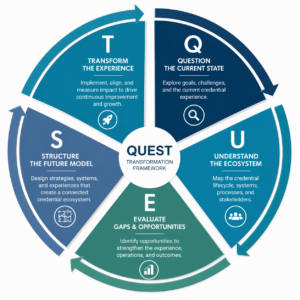
A fractional certification ecosystem leader serves as an experienced strategic partner focused entirely on identifying gaps, aligning programs, and implementing improvements.
Unlike a consultant who delivers recommendations and leaves, a fractional leader becomes part of the team.
Unlike a full-time executive hire, a fractional leader provides expertise without the long-term cost and commitment.
Most importantly, the work happens while your staff continues doing what they do best.
Think about a NASCAR pit crew.
The goal isn’t to stop the race.
The goal is to make improvements so efficiently that the car loses as little momentum as possible.
A fractional leader helps your association do the same thing.
The race continues.
Candidates continue applying.
Programs continue operating.
Revenue continues flowing.
Staff continues serving members.
Meanwhile, strategic improvements are being designed and implemented in parallel.
What Can a Fractional Certification Ecosystem Leader Actually Fix?
The answer is often broader than organizations expect.
A certification ecosystem is not just the exam.
It includes every interaction a professional has with your organization before, during, and after certification.
That means examining:
- Certification strategy and growth opportunities
- Candidate acquisition and marketing
- Exam preparation pathways
- Continuing education alignment
- Conference integration
- Technology systems and data flow
- Renewal and retention strategies
- Volunteer engagement
- Revenue opportunities
- Board-level reporting and metrics
Most associations already have many of these pieces.
The challenge is that they often operate independently rather than as a connected system.
When programs operate in silos, growth becomes unpredictable.
When programs operate as a certification ecosystem, every activity supports the next step in the professional’s journey.
The result is stronger engagement, better retention, and more sustainable revenue growth.
Why Internal Teams Often Struggle to Lead the Change
This isn’t a talent problem.
It’s a bandwidth problem.
The people responsible for running certification programs are often already operating at full capacity.
Adding a major transformation initiative to their workload can feel like asking a driver to change his own tires mid-race.
Even when staff members have excellent ideas, they rarely have enough uninterrupted time to evaluate systems, interview stakeholders, analyze data, facilitate alignment discussions, and manage implementation.
A fractional leader creates dedicated capacity for strategic work without disrupting operational work.
That combination is often what allows meaningful change to finally happen.
The Competitive Advantage of Moving Faster
Many associations are facing increasing competition for attention.
Professionals have more learning options than ever before.
They participate in private communities, industry groups, online learning platforms, social networks, and independent education providers.
Organizations that create seamless certification ecosystems gain a significant advantage.
Professionals experience a clear path forward.
They understand what to do next.
They see value at every step.
And they stay engaged longer.
The associations that wait often find themselves trying to catch up later.
The associations that continuously improve while maintaining operations create momentum that compounds over time.
Just like a race car that receives the right adjustments at the right moment.
Keep Racing. Improve Anyway.
If your certification team knows improvements are needed but lacks the capacity to lead a major transformation effort, you may not need more staff.
You may not need another committee.
You may not need another strategic plan.
You may simply need someone who can work alongside your team and make the improvements while the race continues.
Because the best time to improve your certification ecosystem isn’t after things slow down.
It’s while you’re still moving.
Ready to See How Healthy Your Certification Ecosystem Really Is?
Start by taking the Certification Ecosystem Health Check.
The assessment helps identify strengths, uncover hidden gaps, and highlight opportunities to improve engagement, retention, operational efficiency, and revenue growth across your certification ecosystem.
After completing the Health Check, schedule a conversation with Ellen Maiara to review your results, compare findings with your leadership team, and discuss practical strategies for strengthening your certification ecosystem without disrupting day-to-day operations.
You don’t have to pull into pit road to make meaningful improvements.
You can keep racing while building a stronger future.
Ellen Maiara, CMP, CED, is a Fractional Chief Experience Officer who helps credential-driven associations streamline certification, continuing education, conferences, learning lineups, and overwhelmed program teams, so credentialing becomes a scalable revenue engine.