If you’ve ever taken your car in for a routine inspection, you know the experience.
You may think everything is running perfectly. The engine starts. The tires look fine. The dashboard isn’t flashing warning lights.
Then the mechanic discovers worn brakes, a leaking hose, and tires that won’t survive another road trip.
Nothing was technically broken—yet.
But several small issues were quietly building toward a much bigger problem.
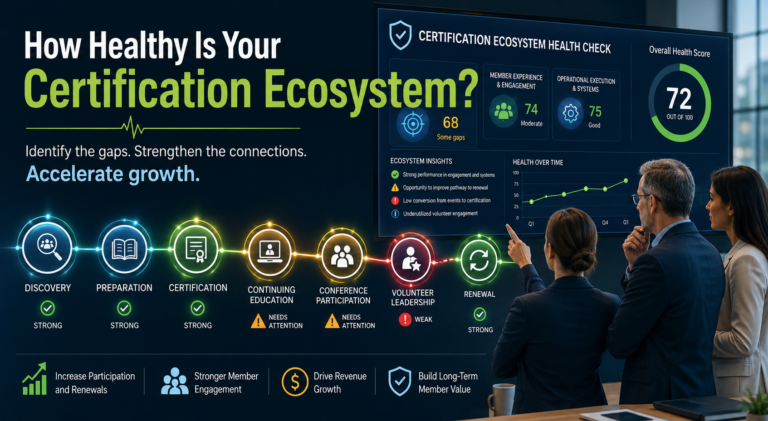
That’s exactly why we created the Certification Ecosystem Health Check.
Most association leaders don’t wake up one morning to discover their certification program has suddenly stalled. The warning signs usually appear gradually:
- Certification applications flatten
- Renewal rates begin slipping
- Conference attendance softens
- Continuing education participation declines
- Volunteer engagement decreases
- Staff become overwhelmed
- Revenue growth slows
The challenge is that these symptoms rarely exist in isolation.
They’re often connected.
And that’s where many organizations run into trouble.
The Problem: Looking at Programs Instead of the Ecosystem
When leaders notice a decline, they often focus on fixing a single component.
Maybe they can redesign the exam.
Maybe they launch a new education program.
Maybe they invest in marketing.
Maybe they will change technology platforms.
These actions may help.
But what if the real issue isn’t any individual program?
What if the problem is how all the pieces work together?
A certification ecosystem isn’t simply a certification exam.
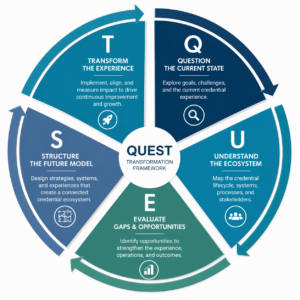
It’s the entire journey professionals experience as they move through your organization:
- Discovering the profession
- Exploring certification
- Preparing for the exam
- Earning certification
- Participating in continuing education
- Attending conferences
- Engaging with peers
- Volunteering
- Renewing certification
- Advancing professionally
Each step should naturally guide participants toward the next.
When that happens, engagement grows.
When it doesn’t, people fall out of the system.
The Cost of an Unhealthy Certification Ecosystem
Think about a bucket with tiny holes drilled into the bottom.
You can keep pouring water into the top all day long.
More marketing.
More webinars.
More conferences.
More promotions.
But if water leaks out faster than you add it, you’ll never fill the bucket.
Many associations unknowingly operate this way.
They spend considerable time and money attracting new certification candidates while overlooking the points where professionals quietly disengage.
The result?
- Lower certification participation
- Reduced renewals
- Lower conference attendance
- Decreased continuing education sales
- Fewer volunteers
- Reduced long-term member value
The issue isn’t always acquisition.
Sometimes it’s retention.
Sometimes it’s engagement.
Sometimes it’s an ecosystem problem.
What the Certification Ecosystem Health Check Measures
The Certification Ecosystem Health Check was designed to help leaders evaluate the overall health of their certification ecosystem.
Rather than examining a single program, it assesses how well the entire system works together.
The assessment explores three critical areas:
Strategy and Revenue Alignment
Does your certification program support organizational goals?
Can leadership clearly identify how certification contributes to revenue, engagement, and professional growth?
Are you measuring the right outcomes?
Member Experience and Engagement
Is the candidate journey intuitive?
Can professionals easily understand what comes next?
Are there clear pathways from certification to continuing education, conference participation, volunteering, and renewal?
Operational Execution and Systems
Do your systems support growth?
Are technology platforms integrated?
Can staff efficiently manage certification operations?
Are data and reporting providing meaningful insights?
The goal isn’t simply to identify weaknesses.
The goal is to uncover opportunities.
What Often Surprises Leadership Teams
One of the most interesting things we see is that leaders often know something feels off.
They just can’t pinpoint where.
After completing the Health Check, common discoveries include:
- Strong certification enrollment but weak renewal pathways
- High conference attendance but low certification conversion
- Great educational content with poor visibility
- Technology systems that create unnecessary friction
- Siloed departments pursuing different goals
None of these issues are unusual.
In fact, they’re incredibly common.
The good news?
They’re also fixable.
Small Changes Can Produce Significant Results
You don’t always need a complete overhaul.
Sometimes, a few strategic adjustments can dramatically improve outcomes.
A clearer candidate pathway.
Better communication between departments.
Improved technology integration.
More intentional engagement opportunities.
Stronger alignment between certification, education, and events.
When the ecosystem functions as a connected system, every component becomes more valuable.
The Question Every Association Should Ask
Most organizations regularly assess finances.
They review conference performance.
They evaluate membership trends.
But very few evaluate the overall health of their certification ecosystem.
And that’s often where the greatest opportunities for growth are hiding.
If certification plays an important role in your organization’s mission, engagement strategy, or revenue model, it’s worth asking:
How healthy is our certification ecosystem?
The answer may reveal opportunities you didn’t know existed.
Take the Certification Program Health Check
If you’re responsible for certification, education, conferences, professional development, or organizational growth, the Certification Program Health Check is designed to help you identify strengths, uncover hidden gaps, and discover opportunities to improve performance across your entire certification ecosystem.
After completing the assessment, let’s talk.
I would be happy to review your results with you, discuss their implications, and explore practical strategies to strengthen your certification ecosystem.
The conversation is complimentary, and you’ll leave with actionable ideas you can implement immediately.
Take the Certification Program Health Check and schedule a call to discuss your results.
Because the most successful certification programs aren’t built by accident.
They’re built intentionally.
Ellen Maiara, CMP, CED, is a Fractional Chief Experience Officer who helps credential-driven associations streamline certification, continuing education, conferences, learning lineups, and overwhelmed program teams, so credentialing becomes a scalable revenue engine.