For months, your staff has been planning.
You select a destination. Negotiate hotel contracts. Build the agenda. Recruit speakers. Sell sponsorships. Open registration. Answer approximately 4,732 questions about dietary restrictions, hotel reservations, session times, and whether someone can still get the early registration rate three weeks after it expired.
Then the conference happens.
Three days later, everyone goes home exhausted.
The staff celebrates. The attendees complete evaluations. The sponsors pack up their booths. Someone posts 800 photos on LinkedIn.
And everyone immediately starts planning next year’s conference.
But here is the question association leaders should be asking:
What did the conference actually accomplish?
Not how many people attended.
Not whether attendees liked the keynote.
Not whether the food was good.
Not even whether the conference made money.
Those things matter. But they do not tell you whether your conference advanced your association’s strategic goals.
Because your conference is not a three-day event.
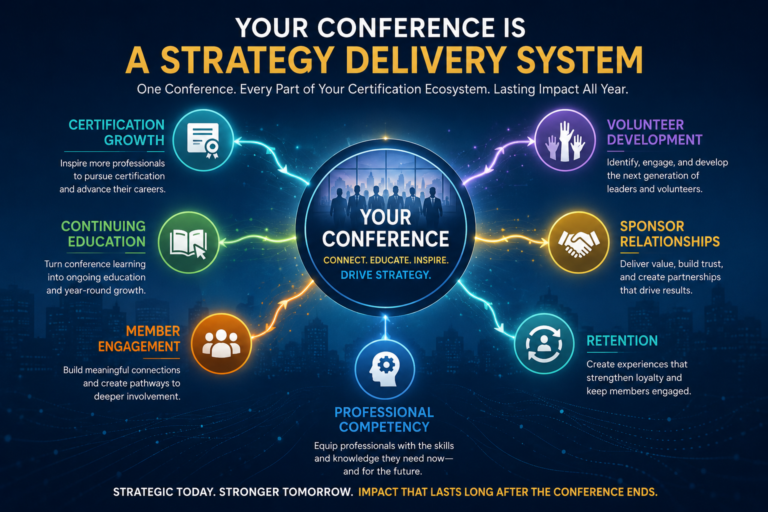
It is a strategy delivery system.
And when it is intentionally designed, it can become one of the most powerful engines in your certification ecosystem.
Stop Treating the Conference as a Standalone Program
In many associations, the annual conference operates in its own organizational universe.
The meetings team plans the conference.
The certification team manages certification.
The education team develops continuing education.
The membership team focuses on engagement and retention.
The marketing team promotes everything.
The sponsorship team sells opportunities.
Everyone is working hard.
The problem is that they may not be working together.
The conference becomes an event on the calendar rather than a strategic platform that connects the association’s most important priorities.
A high-performing certification ecosystem takes a different approach.
Instead of asking:
“How do we create a successful conference?”
Association leaders should ask:
“How can the conference move professionals through our certification ecosystem?”
That one question changes how you think about programming, marketing, technology, engagement, sponsorship, and measurement.
Your Conference Should Drive Certification Growth
How many conference attendees are eligible for your certification but have never pursued it?
Do you know?
More importantly, are you doing anything intentional about it?
Your conference brings together professionals who are already investing in their careers. They have taken time away from work, paid registration fees, traveled to your destination, and committed several days to learning.
That sounds like a pretty good audience for certification.
Yet many associations treat promoting certification at the conference as an afterthought.
Maybe there is a booth.
Maybe there is a slide between general sessions.
Maybe there is a brochure sitting next to the tote bags.
That is not a strategy.
Your conference should help professionals understand where certification fits into their career development.
That might include certification information sessions, candidate meetups, exam preparation opportunities, conversations with certified professionals, or educational pathways that help attendees identify their next professional step.
The goal is not simply to “sell” certification.
The goal is to make certification a visible and logical part of the attendee’s professional journey.
Your Conference Should Increase Continuing Education Participation
Your annual conference may already be your largest continuing education program.
But what happens when attendees go home?
Too often, the answer is: not much.
Attendees earn their hours. Download their certificates. Complete their evaluations.
Then the relationship ends until next year.
What if the conference became the beginning of the next learning opportunity instead?
A session on an emerging issue could lead attendees to an advanced course.
A keynote could introduce a topic that will be explored through a webinar series.
A conference learning track could connect directly to a continuing education pathway.
The conference should not represent three days of isolated learning.
It should help attendees answer:
“What should I learn next?”
When conference programming and continuing education strategy are connected, the association can extend engagement far beyond the closing session.
Your Conference Should Strengthen Member Engagement
Conferences create something that associations struggle to replicate anywhere else:
Connection.
People meet colleagues.
They share challenges.
They exchange ideas.
They discover that someone else is dealing with the exact same problem that has been keeping them awake at 2:00 a.m.
Those relationships are incredibly valuable.
But associations often leave that engagement to chance.
Strategic conferences intentionally create pathways for attendees to become more involved.
A first-time attendee might be introduced to a community.
A longtime member might discover a mentoring opportunity.
A certified professional might meet a future candidate.
An emerging leader might connect with a committee chair.
The conference should not simply create networking opportunities.
It should create engagement pathways.
Your Conference Should Build Professional Competency
A packed agenda is not necessarily an effective learning strategy.
Yes, I said it.
Sometimes we become so focused on filling every available breakout room that we forget to ask whether the sessions collectively help professionals do their jobs better.
Conference education should connect to the competencies professionals need now—and the ones they will need next.
That requires looking beyond individual session proposals.
What workforce changes are affecting the profession?
Where are professionals struggling?
What emerging skills will become essential?
Where are the competency gaps?
How does conference education support certification and continuing education?
The answers should influence the conference program.
Otherwise, you may have 75 excellent sessions that collectively lead nowhere.
Your Conference Should Develop Future Volunteers and Leaders
Every association needs volunteers.
And many associations struggle to find them.
Meanwhile, hundreds or thousands of potential volunteers may be walking around the annual conference wearing name badges.
The problem is not always a lack of interest.
Sometimes people simply do not know how to get involved.
Or they assume volunteering requires a three-year commitment, twelve committee meetings, six conference calls, and possibly the surrender of their firstborn child.
Your conference can change that perception.
Create small, accessible entry points.
Invite attendees to contribute their expertise.
Introduce emerging professionals to current volunteers.
Show people how volunteer involvement can support their own professional development.
The conference should help the association identify and cultivate its next generation of leaders.
Your Conference Should Strengthen Sponsor Relationships
Sponsors do not simply want booth traffic.
They want results.
And yet many sponsorship strategies still revolve around a familiar formula:
Logo.
Booth.
Lanyard.
Reception.
Repeat.
A conference designed as a strategy delivery system creates more meaningful opportunities.
Sponsors can support professional education.
They can contribute expertise.
They can help solve industry challenges.
They can build relationships with clearly defined audience segments.
They can become part of year-round initiatives that begin—or gain momentum—at the conference.
This changes the conversation from:
“Would you like to buy a sponsorship?”
to:
“How can we help you build meaningful relationships with the professionals you want to reach?”
That is a very different value proposition.
Your Conference Should Improve Retention
Why do members renew?
Why do certified professionals recertify?
Why do conference attendees return?
The answers are often connected.
People stay engaged when they continue to see value.
A strategically designed conference can remind attendees why the association matters.
It can reconnect them with colleagues.
Help them build new skills.
Introduce them to new opportunities.
Strengthen their professional identity.
Show them the next step in their career development.
But that only works if the conference experience is connected to what happens before and after the event.
Retention is not created by sending a renewal invoice.
It is created by consistently delivering value throughout the certification ecosystem.
The conference can play a major role in that process.
The Real Question Is Not Whether Your Conference Was Successful
Most associations can tell you:
How many people attended?
How much revenue did the conference generate?
How many sponsors participated?
Which sessions received the highest ratings?
Those are useful metrics.
But they are only part of the story.
Association leaders should also be asking:
Did conference attendees enter the certification pipeline?
Did continuing education participation increase?
Did members become more engaged?
Did professionals develop critical competencies?
Did new volunteers emerge?
Did sponsor relationships grow stronger?
Did attendees remain connected to the association?
Did the conference improve retention?
Those questions reveal something far more important than whether people enjoyed the conference.
They reveal whether the conference delivered on its strategy.
Your Conference Is Too Valuable to Last Only Three Days
Associations invest enormous amounts of time, money, and staff resources into their annual conferences.
That investment should produce more than three days of education and networking.
Your conference should drive certification growth.
Increase continuing education participation.
Strengthen member engagement.
Develop professional competency.
Create future volunteers.
Build stronger sponsor relationships.
Improve retention.
In other words, your conference should connect and strengthen the entire certification ecosystem.
When certification, education, conferences, technology, marketing, membership, and engagement operate independently, opportunities disappear between the organizational silos.
But when they work together, the conference becomes something much more powerful.
It becomes a strategy delivery system.
Is Your Certification Ecosystem Working Together?
If your conference, certification programs, continuing education, membership, marketing, and technology feel more like separate departments than a connected strategy, it may be time to look at the bigger picture.
Take the Certification Program Health Check.
In just a few minutes, you can identify strengths, uncover gaps, and see where disconnected programs may be limiting growth, engagement, and revenue.
Then, set up a call with me to discuss what you discovered.
Together, we can explore how your conference and the rest of your certification ecosystem can work together to create stronger professional pathways, better experiences, and measurable results.
Because your conference should not disappear when the ballroom doors close.
It should move your strategy forward.
Ellen Maiara, CMP, CED, is a Fractional Chief Experience Officer who helps credential-driven associations streamline certification, continuing education, conferences, learning lineups, and overwhelmed program teams, so credentialing becomes a scalable revenue engine.