
… The Ecosystem is broken
Many associations celebrate the moment a member earns certification.
The emails go out.
The social posts get published.
Leadership celebrates another successful candidate.
And then… silence.
Six months later:
- engagement drops
- continuing education participation slows
- event attendance declines
- renewals become harder
- members quietly disappear
At first glance, it looks like a retention problem.
It’s not.
It’s an ecosystem problem.
Because certification was treated like the finish line instead of part of a connected professional journey.
Certification Is Not the End of the Journey
One of the biggest mistakes associations make is designing certification as an isolated program.
A member studies.
They pass the exam.
They earn the letters after their name.
And then the organization unintentionally leaves them standing alone.
No intentional next step.
No structured pathway.
No integrated engagement strategy.
That creates a dangerous gap between:
- certification
- continuing education
- conferences
- leadership development
- community engagement
When those systems operate independently, members disconnect after certification because there is no visible reason to stay engaged.
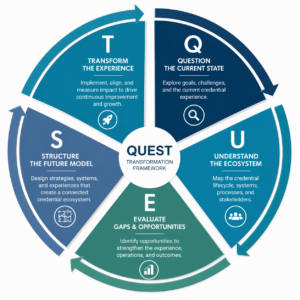
The Certification Ecosystem Most Associations Never Design
Strong associations do not think in terms of separate programs.
They design an interconnected certification ecosystem.
In a healthy ecosystem:
- conferences reinforce certification value
- education supports career advancement
- certification creates professional identity
- leadership opportunities deepen engagement
- continuing education becomes part of a long-term growth pathway
Everything works together.
The member never feels like they “finished.”
They feel like they are progressing.
That distinction changes everything.
The Warning Signs of a Broken Certification Ecosystem
Many organizations do not realize the ecosystem is fragmented until growth stalls.
Here are some of the most common warning signs:
Certification Growth Has Plateaued
Applications flatten even though demand for professional development exists.
Members Disappear After Passing the Exam
Engagement drops immediately after certification.
Conferences Feel Separate From Certification
Sessions are not aligned to certification goals or continuing education strategy.
Continuing Education Feels Transactional
Education becomes “hours collection” instead of professional advancement.
Teams Operate in Silos
Certification, education, and events are managed independently with little strategic alignment.
Leadership Wants Growth But Systems Cannot Support It
The organization wants scalable revenue and engagement without redesigning the infrastructure that drives both.
Sound familiar?
You are not dealing with a marketing problem.
You are dealing with ecosystem fragmentation.
Why This Matters More Than Ever
Today’s professionals expect clear pathways.
They want:
- relevance
- career progression
- meaningful learning experiences
- professional recognition
- community
- ongoing value
If the organization only engages them during exam preparation and renewal season, they eventually disengage.
Not because certification lacks value.
Because the ecosystem around it was never intentionally designed.
Associations that win in the future will not simply offer certification.
They will create connected professional journeys that continuously reinforce engagement and value.
What a Healthy Certification Ecosystem Looks Like
A healthy certification ecosystem creates momentum.
Members move naturally between:
- learning
- events
- certification
- leadership
- renewal
- advocacy
The experience feels connected.
The systems support growth instead of creating friction.
And leadership gains:
- stronger retention
- increased participation
- more predictable revenue
- clearer engagement metrics
- higher long-term member value
Most importantly, the organization stops relying on disconnected programs to create sustainable growth.
Because growth is not a campaign.
It is a system.
The Real Opportunity
Many associations already have excellent programs.
Excellent conferences.
Excellent certification.
Excellent education.
The issue is not quality.
The issue is alignment.
When the ecosystem becomes connected, everything becomes more effective:
- certification drives engagement
- conferences reinforce learning
- education supports advancement
- members stay connected longer
- growth becomes more predictable
That is where transformation happens.
Ready to See Where Your Ecosystem Is Breaking Down?
If members disappear after certification, there are likely hidden gaps inside your certification ecosystem.
The good news?
Those gaps can be identified.
👉 Start with the Certification Ecosystem Health Check to evaluate how your certification, education, and event strategies work together.
Then schedule a conversation with me to discuss:
- where engagement is breaking down
- where revenue opportunities are being missed
- how to create a more connected certification ecosystem
Because the goal is not just earning certification.
The goal is to create long-term professional engagement.
Ellen Maiara, CMP, CED, is a Fractional Chief Experience Officer who helps credential-driven associations streamline certification, continuing education, conferences, learning lineups, and overwhelmed program teams, so credentialing becomes a scalable revenue engine.