
Many associations believe their certification programs drive membership growth and engagement. But in many organizations, the opposite is quietly happening.
The certification program becomes the point where member engagement begins to decline. This isn’t because the certification lacks value. In fact, most certifications are highly respected within their professions.
The real issue is something deeper: the certification ecosystem was never intentionally designed.
Over time, certification programs evolve. New courses are added. Conferences expand. Continuing education requirements change. Technology platforms are layered on top of one another.
Eventually, the certification ecosystem begins to look something like this:
- an exam program
- a catalog of continuing education courses
- an annual conference
- renewal requirements
- scattered webinars
- multiple learning and technology platforms
Individually, these programs work. But together, they rarely create a cohesive professional journey for members. And that’s where the hidden problem begins.
The Certification Journey Is Often Fragmented
From a member’s perspective, certification should feel like a clear professional journey:
Discovery → Preparation → Certification → Growth → Renewal → Leadership
Instead, many certification holders experience something very different.
They earn the certification… and then ask: What do I do next?”
Continuing education options feel random. Conference programming may not reinforce the certification. Learning pathways are unclear. Renewal becomes a compliance exercise instead of a growth opportunity.
When a certification ecosystem lacks structure, engagement naturally declines. Not because members don’t care. But the organization hasn’t created a clear path for them to continue growing.
The Impact of a Fragmented Certification Ecosystem
A fragmented certification ecosystem creates challenges that association leaders often struggle to explain.
They see symptoms, but the root cause remains unclear.
Common signs include:
- Member engagement drops after certification
- Continuing education participation fluctuates
- Conferences feel disconnected from professional development
- Revenue from learning programs becomes unpredictable
Eventually, boards begin asking difficult questions:
- How do we grow the certification program?
- How do we increase member engagement?
- Why aren’t certification holders staying involved?
Many organizations assume the answer is better marketing.
But the real answer is often ecosystem design.
Certification Is More Than an Exam
The most successful associations understand an important truth:
Certification is not just a program.
It is the center of the professional experience your organization provides.
When designed intentionally, a certification ecosystem becomes the engine that drives:
- long-term member engagement
- continuing education participation
- conference value
- professional identity
- sustainable non-dues revenue
Certification should not mark the end of a professional journey.
It should mark the beginning of one.
Designing a Certification Ecosystem That Drives Engagement
Associations that thrive in certification think differently.
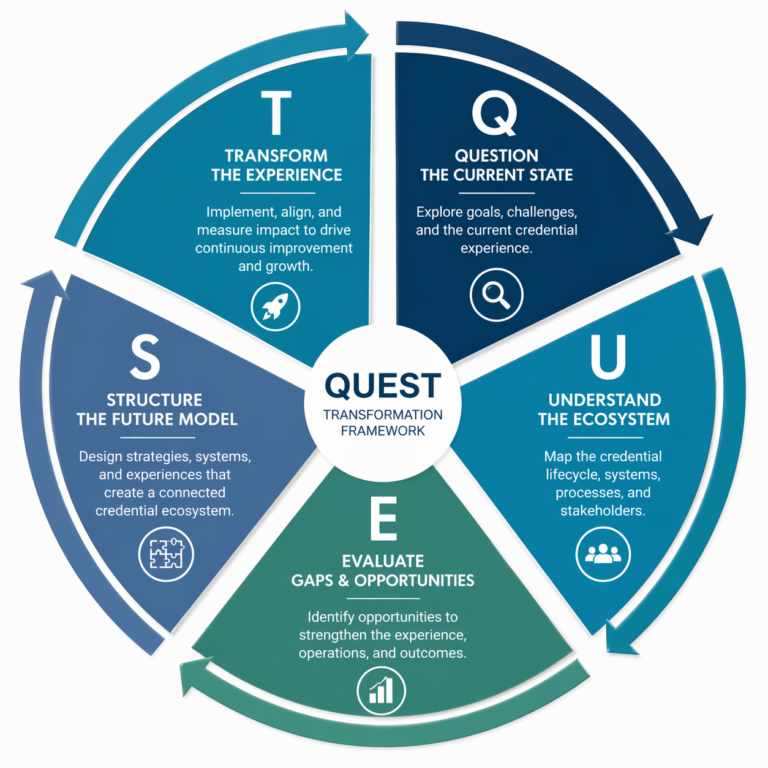
Instead of managing separate programs, they design a connected certification ecosystem where:
- certification programs
- learning and continuing education
- conferences and events
- professional communities
all reinforce one another.
Members can clearly see:
Where they start. How they grow. What comes next?
When a certification ecosystem is intentionally designed, engagement doesn’t decline after certification.
It accelerates.
And the certification becomes what it was always meant to be:
A professional journey that keeps members connected to the association for years.
Ellen Maiara, CMP, CED, is a Fractional Chief Experience Officer who helps certification-driven associations streamline certification, continuing education, conferences, learning lineups, and overwhelmed program teams, so certification becomes a scalable revenue engine.
Is Your Certification Ecosystem Thriving or Fragmented? Take this 5-minute assessment and find out. Certification Ecosystem Health Check