Let me start with a slightly uncomfortable observation.
Most associations spend enormous amounts of time talking about membership growth and sponsorship revenue.
Membership committees meet about it.
Boards debate it.
Strategic plans revolve around it.
But in many organizations, the largest untapped revenue opportunity is sitting quietly in the background.
And it isn’t sponsorship.
It isn’t membership.
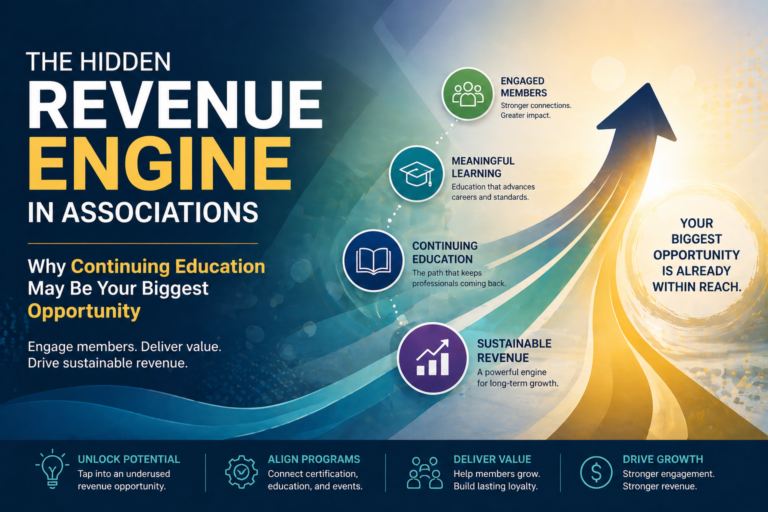
It’s continuing education.
Yes, the same continuing education program that is often treated like the quiet cousin of the conference department.
The one that gets discussed right after coffee breaks and before someone asks if the Wi-Fi password changed again.
Why Continuing Education Is So Powerful
Continuing education sits at the intersection of three things associations are uniquely positioned to deliver:
- Professional credibility
- Career advancement
- Community learning
Professionals already trust associations to define standards in their industries.
That means associations are naturally positioned to deliver high-value professional education.
And unlike sponsorship revenue—which fluctuates with marketing budgets—continuing education is often tied to something far more predictable:
Professional necessity.
Many professionals need education hours to maintain a certification.
That demand already exists.
The real question is whether associations have designed programs that effectively capture it.
Where Many Associations Leave Money on the Table
In many organizations, continuing education programs grow organically.
A webinar here.
A conference track there.
Maybe an online course library someone built during the pandemic.
Individually, these programs work.
Collectively… they often resemble a drawer full of phone chargers.
Technically useful.
But nobody knows which one fits what.
Common issues include:
- Education programs built around internal schedules instead of learner needs
- Conferences and education operate independently
- Certification renewal requirements that confuse members
- Technology platforms that make tracking education difficult
- Pricing that undervalues the content
When this happens, continuing education becomes a compliance requirement instead of a strategic revenue engine.
What a Strong Continuing Education Strategy Looks Like
Associations that unlock the revenue potential of continuing education tend to think differently.
They stop thinking about individual programs and start thinking about professional journeys.
In a well-designed system:
Certification becomes the starting point, not the finish line.
Education supports professionals before and after they earn certification.
Conferences reinforce learning and provide education hours.
Online courses extend the value of conference content throughout the year.
Members always understand:
- What to learn next
- How to maintain their certification
- Where to track their education progress
When everything connects, something powerful happens.
Education becomes a continuous engagement loop.
And that loop drives:
- Higher member retention
- Stronger conference attendance
- More education revenue
- Greater long-term engagement
Why This Matters Right Now
Professionals today have more options for learning than ever before.
They can turn to:
- Independent training providers
- Online learning platforms
- Industry influencers
- Niche certification programs
Associations can no longer assume professionals will stay within their ecosystem.
Organizations that succeed will be those that design clear, professional learning journeys centered on certification.
When that happens, professionals don’t just earn a certification.
They build their careers around it.
A Question Worth Asking
If you’re part of an association leadership team, consider this question:
Is your certification program operating as a standalone product… or as the center of a connected learning experience?
Many associations already have everything they need to create powerful education programs:
- Industry expertise
- Respected certification programs
- Conference content
- Engaged members
What’s often missing is the strategy that connects certification, continuing education, and conferences into one cohesive experience.
Start With the Certification Program Health Check
If you’re curious about how well your certification programs, continuing education, and events are working together, a great place to start is the Certification Program Health Check.
This short assessment helps associations evaluate how effectively their programs work together to support:
- Member engagement
- Professional value
- Sustainable revenue growth
👉 Take the Certification Program Health Check
After completing the assessment, you’ll gain insights into where your certification and education programs are strong—and where there may be opportunities to improve alignment.
And if you’d like to explore what a stronger continuing education strategy could look like for your organization, I’d be happy to talk.
Sometimes the biggest opportunity isn’t launching something new.
It’s simply connecting the programs you already have.
Ellen Maiara, CMP, CED, is a Fractional Chief Experience Officer who helps certification-driven associations streamline certification, continuing education, conferences, learning lineups, and overwhelmed program teams, so certification becomes a scalable revenue engine.