
For decades, associations have relied on a familiar formula for financial sustainability:
- Membership dues
- Sponsorships
- Annual conferences
But many organizations are overlooking one of their most powerful and scalable revenue opportunities.
Continuing education.
When designed strategically, continuing education (CE) can become one of the most reliable, mission-aligned revenue engines an association has. Yet in many organizations, CE programs are treated primarily as compliance requirements rather than strategic growth drivers.
And that represents a significant missed opportunity.
Why Continuing Education Is So Powerful for Associations
Continuing education sits at the intersection of three things associations are uniquely positioned to provide:
- Professional credibility
- Ongoing career advancement
- Community-driven learning
Members and certification holders already trust associations as the authoritative source for professional standards and knowledge. That trust makes associations the natural home for lifelong learning.
Unlike sponsorship revenue, which can fluctuate with economic conditions, education revenue is tied directly to professional necessity. Many professionals must earn continuing education credits to maintain licenses and certifications.
The demand already exists.
The question is whether associations have designed systems that allow them to capture and scale that demand.
Where Many Associations Leave Revenue on the Table
In many organizations, continuing education evolves organically over time.
A few webinars here.
A conference track there.
Maybe a small online course library.
Individually, these programs can be successful. But together they rarely form a cohesive learning ecosystem.
Common challenges include:
- Education programs operating in silos
- Conferences and certification programs not aligned
- CE offerings designed around internal capacity rather than learner demand
- Technology platforms that create friction for participants
- Pricing structures that undervalue educational content
When this happens, continuing education becomes a service obligation instead of a strategic asset.
What a High-Performing Continuing Education Ecosystem Looks Like
Associations that successfully grow education revenue think differently.
They don’t design isolated programs.
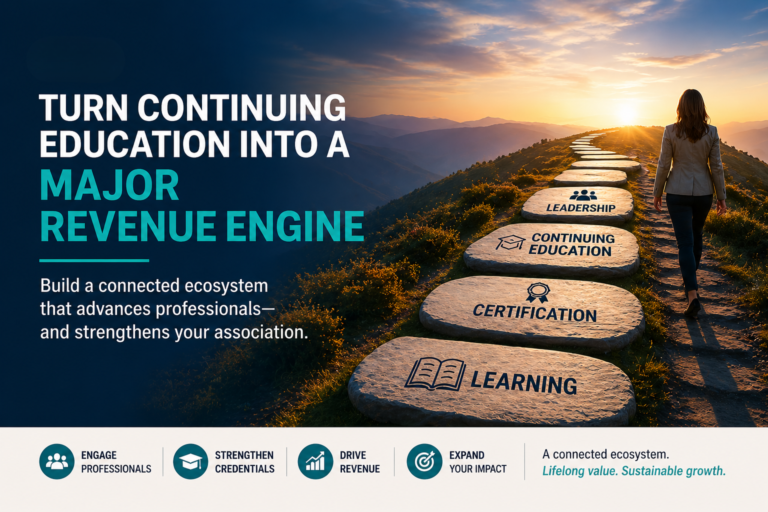
They design certification ecosystems.
In a strong ecosystem:
Clear Learning Pathways
Professionals understand how courses and certifications support their career progression.
Education Supports Certification
Courses prepare professionals for certification and help them maintain certifications through continuing education.
Conferences Fuel the Learning Pipeline
Conference sessions evolve into workshops, certificate programs, and on-demand learning.
Learning Happens Year-Round
Revenue is no longer tied only to the annual conference cycle.
The Experience Is Seamless
Participants can easily register, track credits, and see what their next learning step should be.
When these elements align, continuing education stops being just another program.
It becomes a growth engine.
The Financial Impact of Strategic Continuing Education
Associations that intentionally design their certification ecosystems often see measurable benefits:
Predictable Revenue
Courses, certificates, subscriptions, and certification maintenance create recurring income.
Stronger Member Engagement
Professionals return frequently to maintain certifications and pursue new learning.
Higher Certification Value
Education strengthens certification programs and professional standards.
Expanded Audience Reach
Many professionals first engage with an association through education before becoming members.
In some cases, education revenue can rival or exceed sponsorship revenue.
The Strategic Question Associations Should Be Asking
Many associations ask:
“What courses should we offer next?”
But the more powerful question is:
“What professional journey are we responsible for guiding?”
When continuing education is designed around the entire lifecycle of a professional — from entry into the field through leadership — it becomes central to both the association’s mission and its financial sustainability.
That is where the real opportunity lies.
Associations don’t need more webinars.
They need intentional certification ecosystems that connect education, certification, conferences, and professional growth.
When those elements align, continuing education stops being something organizations manage.
It becomes a powerful engine for impact, engagement, and revenue.
How Strong Is Your Certification Ecosystem?
If you’re wondering how well your organization’s certification and continuing education strategy is working today, a good place to start is the Certification Program Health Check.
This assessment helps association leaders evaluate how effectively their certification programs, education offerings, and events work together to support a strong credential ecosystem and professional learning pathway.
After completing the assessment, you’ll receive insights into:
- Strengths within your current certification and education programs
- Opportunities to better align conferences, certifications, and continuing education
- Areas where a more intentional credential ecosystem could increase engagement and revenue
It’s a simple way to begin viewing your programs through the lens of a connected professional development ecosystem.
Take the Certification Program Health Check
If you’d like to discuss your results or explore what a more intentional association certification and continuing education strategy could look like, I’d be happy to talk.
Together, we can explore how your certification program, continuing education, and events can work as one connected experience.
Ellen Maiara, CMP, CED, is a Fractional Chief Experience Officer who helps certification-driven associations streamline certification, continuing education, conferences, learning lineups, and overwhelmed program teams, so certifications become a scalable revenue engine.