Most associations believe they have a strong certification program.
The exam is solid.
The content is respected.
The industry recognizes it.
So, when growth slows—or stalls entirely—it’s confusing.
Because on the surface, everything looks like it should be working.
But here’s the problem:
Most certification journeys are never actually mapped.
What’s Missing Isn’t Quality—It’s Connection
In many organizations, certification exists as a standalone achievement.
- Candidates study → pass the exam → get certified
- Then… they’re on their own
Continuing education lives somewhere else.
Conferences operate independently.
Learning pathways aren’t clearly defined.
Each piece works.
But they don’t work together.
And that’s where the breakdown happens.
The Invisible Drop-Off Points
When the certification ecosystem isn’t designed intentionally, members hit friction points:
- They don’t know how to start the certification process
- They’re unsure what education counts toward eligibility
- They struggle to find continuing education after certification
- They don’t see a clear path forward after renewal
So what do they do?
They disengage.
Not because they don’t value certification—
but because the path is unclear.
Why This Impacts Growth More Than You Think
This isn’t just a member experience issue.
It’s a revenue and sustainability issue.
When the certification ecosystem isn’t connected:
- Certification enrollments plateau
- Continuing education underperforms
- Conferences miss opportunities to reinforce certification
- Member engagement becomes inconsistent
You’re not just losing participation.
You’re losing momentum.
What a Mapped Certification Ecosystem Looks Like
High-performing organizations do something differently.
They design certification as part of a connected ecosystem, not a single milestone.
That means:
- A clear entry point into certification
- Learning experiences that guide candidates forward
- Conferences that reinforce certification progress
- Continuing education that supports long-term growth
- Defined pathways from first interaction to renewal and beyond
Instead of asking:
“Why aren’t people enrolling?”
They ask:
“Where is the journey breaking down?”
The Shift: From Programs to Systems
If your certification growth has slowed, it’s tempting to tweak individual components:
- Update the exam
- Add more courses
- Promote certification more heavily
But those changes rarely create a lasting impact.
Because this isn’t a program problem.
It’s a system problem.
Until the certification ecosystem is aligned,
you’ll keep fixing symptoms instead of solving the root cause.
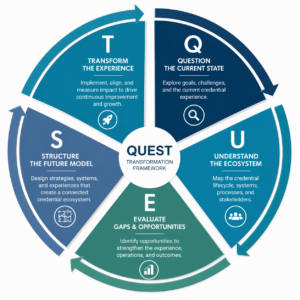
How to Start Mapping Your Certification Ecosystem
You don’t need a full redesign to begin.
Start by asking:
- Can a member clearly see how to move from interest to certification?
- Do your conferences actively support certification progression?
- Is continuing education aligned with certification goals?
- Can your team track where people drop off in the journey?
If the answer to any of these is unclear—
That’s where your opportunity is.
Take the Assessment
If you’re wondering how your certification ecosystem is actually performing, the best place to start is with a structured evaluation.
👉 Take the Certification Program Health Check
It will help you quickly identify:
- Where your ecosystem is disconnected
- Where engagement is breaking down
- Where growth opportunities exist
And if you want to talk through your results and what to do next:
👉 Schedule a conversation with me
We’ll walk through your ecosystem and identify the highest-impact opportunities to improve performance, engagement, and revenue.
Ellen Maiara, CMP, CED, is a Fractional Chief Experience Officer who helps credential-driven associations streamline certification, continuing education, conferences, learning lineups, and overwhelmed program teams, so credentialing becomes a scalable revenue engine.